• Notice for iPhone users: DO NOT use the image size reduction option when uploading photos to the forum. This causes portrait images to post as landscape. We have added a warning to the image insert pop-up as well.

fuel lines

opelgtboy

Legacy Registered User
City
Glassboro
State
NJ
Does anybody know what the 2 items located in the rear of the Scrambler behind the driver's taillight are? One is plastic and looks like a fuel filter and mounts behind the taillight and the other is a small metal canister looking thing. Both have fuel lines running in and out of them. Are these for the actual fuel or are they for the emissions system?

If you need a pic I can get it.

Karl
 
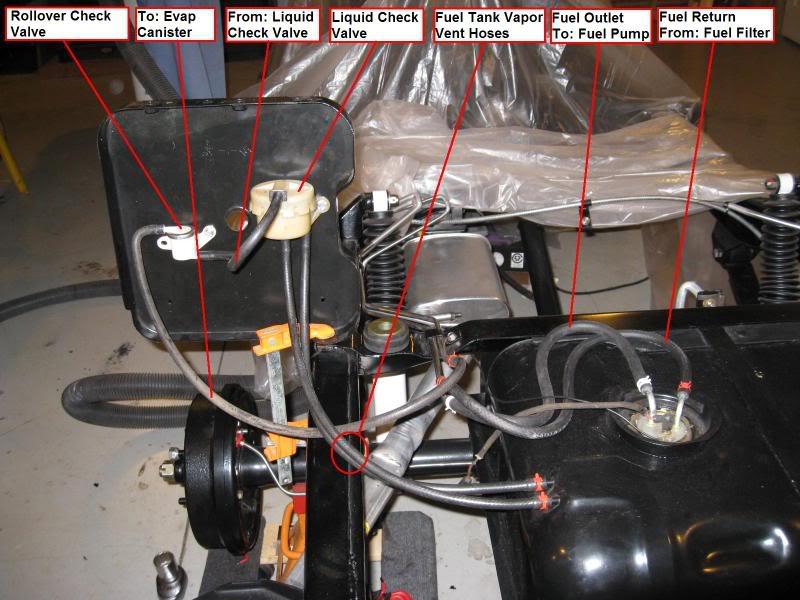
That's odd. There's nothing behind my light. Only the fill/vent hoses going to the filler neck. That seems like a really random place to put fuel lines since the other fuel system lines go nowhere near the tail light. I have an 82' with all the stock CA emissions gear. Can you find it in this pic?

fuelSystemParts-1.jpg
 
Liquid Check Valve and Roll-over valve. ROV is available aftermarket from Delorean motor company (DMC), LCV is hopefully intact enough for you to rebuild:

forum
 
That is them.

Which one is which valve?

Do you need these valves or can you by-pass them?

Karl
 
Ok

Big one is liquid check valve and little one is roll over valve.

I have a 20 gallon tank. The previous owner put it in. I have Howell TBI.

Do I need these 2 items?

The LCV has a damage bottom tube.

Karl
 
For the 20 gallon factory tank, you do not need these. There are two vent/rollover valves built into the tank setup.

Aftermarket tanks vent in the same manner as the 15 gallon factory tanks. So for aftermarket you will need these.
 
^^what he said^^ If your LCV is intact and your tank is an original transplant, then you may try selling the LCV on eBay. I thought there was a good market for it, but apparently it's not as good as I thought. $30+ maybe?
 
Last edited:
What does the LCV do?

What does the ROV valve do?

Does anybody have a good one for sale?

Is there a thread on repairing these? I searched and didnt find one.

Karl
 
Last edited:
LCV: Allows vapor expansion in the tank by collecting vapors and then allowing them to condense and return to the tank as liquid gasoline. If you don't have an LCV, you potentially run into either vapor leak which is like a small hole in your pocketbook and also is an environmental concern.

ROV: Acts as a one-way valve allowing some of the vapors to proceed on to the charcoal canister to be recycled through the carb/TBI when the vehicle is upright; when the vehicle is upside down, that one-way valve closes and keeps fuel from spilling out and your Jeep going "boom."

There is an LCV on eBay right now, and ROVs are available aftermarket through DMC (search google for DMC roll over valve and you should find it).

The ROVs are generally unrepairable since they were made of metal and usually rusted beyond recognition. The LCVs are pretty straightforward - there is a top, a bottom, and a float with brass needles. The top and bottom are made of plastic and occasionally are missing a nipple that you'll need to replace with a brass fitting and some two-part epoxy:

img1200b.jpg


See also, this thread: JF thread on LCVs and ROVs

:thumbsup:
 
I thought I had my LCV repaired. Now Im not sure.

Should the LCV have fuel pressure going through it?

When my Jeep is at idle I dont have any leaks. When I drive it a few blocks and stop, there is gas on the bottom of the LCV dripping down. When I disconnect the left bottom hose, the hose is full of gas. Is this correct?

Does anybody have a fuel system diagram with the LCV?

Karl
 
Contact JeepDreamer - he had a similar problem and gas was streaming out of his canister. Also check the JF thread I posted above, here's the most important image in that thread:

CopyofCheckValveRouting-1.jpg


If there's gas coming from the bottom, that tells me that one of your return hoses to the tank is obstructed. Can you blow through both of them freely? (don't inhale!)
 
I found that pic in the thread, thanks. I will have to check the return lines.

I thought I only had one return line?

Karl
 
Ok, I have more info.

Gas line to engine is connected properly to tank.

Return line from engine to tank is connected properly.

Line from LCV to ROV is connected properly.

The line from the ROV to the charcoal canister is another story.
I dont have a charcoal canister. It was taken out by the previous owner. The top line of the ROV is not hooked up to anything. It runs the length of the frame to the engine and then stops. It does not have a plug either.

How am I getting gas into the LCV? Im lost.

Should my Jeep have a vented gas cap? Can I just disconnect the 2 lines that run to the LCV and make a loop out of them?

If someone is willing to let me call them to talk about this send me your number in a private message.

Karl
 
I may be available later - I'll shoot you a PM. You've tried blowing through the ones running to the tank to make sure they're both patent?

I don't know enough about the system to know what the lack of a canister would do (it's only supposed to hold vapors - not raw gas), but I would suggest getting one, making sure the line to it is patent (mine was plugged with charcoal), and hooking everything up. A canister runs $25-30 from most junkyards or online, and you can use a YJ canister if you need to.

And yes, a vented gas cap. I would be surprised if yours isn't - perhaps it is and has gone bad. And I'd be surprised if you were able to run it that way, because no venting usually = vapor lock. Air vents in, though, not out, so I'm not sure it would solve your problem.

PM coming.
 
Last edited:
It looks like I have the fuel leak resolved.

I had my brother talk to some of his mechanic friends and they informed me that that LCV will get gas in it, though not alot. That is why it has the float in it. I bought the one off ebay and used the bottom half with my top half and put a new rubber seal in it. It didnt leak. The leak it turns out was from an old rubber seal not sealing. The gas was coming from in between the two halves.

Thanks for all your help.

Karl
 
Back
Top