

You are using an out of date browser. It may not display this or other websites correctly.
You should upgrade or use an alternative browser.
You should upgrade or use an alternative browser.
Electric cooling fan
- Thread starter DougCJ8
- Start date


jscherb
CJ-8 Member
- City
- Elmira
- State
- NY
For a CJ-8, a Ford Contour dual fan is a better choice - it's a perfect fit for the radiator, and it is thnner than the Taurus fan, so there's no problem fitting it between the water pump pulley and the radiator..
Here's what mine looked like when I installed in in my Scrambler radiator...
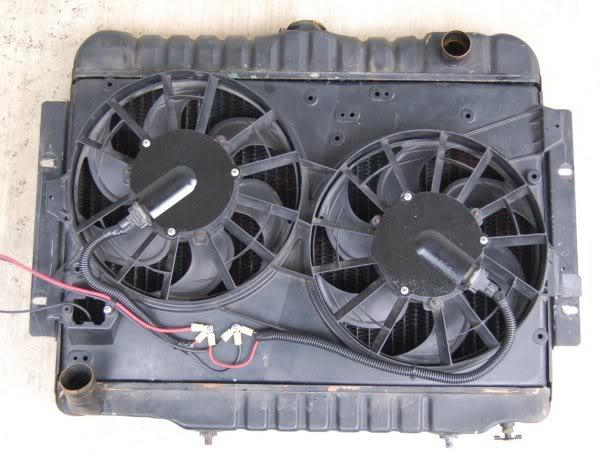
This dual fan is from a a mid-nineties Ford Contour SVT with the higher performance engine option – either the 16 valve “Zetec” engine or the 24 valve 2.5l “Duratec” V-6. The dual fans pull 3400 CFM in total and also provide redundancy in the event of the failure of a one of the fans. The Contour fan is also more than an inch thinner than the Taurus fan at the motors, and it is a little less then 3 inches thick between the motors where it would meet the water pump pulley, so it fits perfectly no trimming of the shroud necessary.
Here's what mine looked like when I installed in in my Scrambler radiator...
This dual fan is from a a mid-nineties Ford Contour SVT with the higher performance engine option – either the 16 valve “Zetec” engine or the 24 valve 2.5l “Duratec” V-6. The dual fans pull 3400 CFM in total and also provide redundancy in the event of the failure of a one of the fans. The Contour fan is also more than an inch thinner than the Taurus fan at the motors, and it is a little less then 3 inches thick between the motors where it would meet the water pump pulley, so it fits perfectly no trimming of the shroud necessary.

4miles
CJ-8 Member
- City
- Virginia Beach
- State
- VA
For a CJ-8, a Ford Contour dual fan is a better choice - it's a perfect fit for the radiator, and it is thnner than the Taurus fan, so there's no problem fitting it between the water pump pulley and the radiator..
Here's what mine looked like when I installed in in my Scrambler radiator...
That looks like a perfect fit. I like the ideal of backup in case of failure. How did you wire it in?
Last edited:
jscherb
CJ-8 Member
- City
- Elmira
- State
- NY
That looks like a perfect fit. I like the ideal of backup in case of failure. How did you wire it in?
I used a DC Control electronic variable speed controller with a radiator probe temp sensor.
The DC Control unit is a great piece of technology, but they are somewhat challenged when it comes to customer service, so if I were doing it again today, I'd use a Flex-A-Lite controller, they have an electronic variable speed one with the same features as the DC Control unit.
I also built a small fan control box that I mounted on my dash - the top LED glows green when the fan isn't running, and as the controller starts spinning the fan, the LED goes from green to yellow to red depending on how fast the fan is spinning. The fan speed is a function of the electronic controller, the more cooling needed, the faster the fan goes. The switch provides manual control of the fan, it has three positions - always on, normal (automatically controlled by the electronic controller), and always off.

4miles
CJ-8 Member
- City
- Virginia Beach
- State
- VA
I used a DC Control electronic variable speed controller with a radiator probe temp sensor.
The DC Control unit is a great piece of technology, but they are somewhat challenged when it comes to customer service, so if I were doing it again today, I'd use a Flex-A-Lite controller, they have an electronic variable speed one with the same features as the DC Control unit.
I also built a small fan control box that I mounted on my dash - the top LED glows green when the fan isn't running, and as the controller starts spinning the fan, the LED goes from green to yellow to red depending on how fast the fan is spinning. The fan speed is a function of the electronic controller, the more cooling needed, the faster the fan goes. The switch provides manual control of the fan, it has three positions - always on, normal (automatically controlled by the electronic controller), and always off.
Thanks, I knew when I asked that you went that extra step....... The override switch comes with the Flex-A-Lite controller, but knowing the speed would be a nice feature. I found their light on the DC Control website.
Last edited:
JEEPTHRILLS
Legacy Registered User
- City
- 00
- State
- 00
Jscherb....where did you find that great little check engine light??
jscherb
CJ-8 Member
- City
- Elmira
- State
- NY
Thanks, I knew when I asked that you went that extra step....... The override switch comes with the Flex-A-Lite controller, but knowing the speed would be a nice feature. I found their light on the DC Control website.
I used a red + green bi-color, common cathode LED. The cathode is wired to ground, the anode of the red LED is wired to the controller output (through an 1k ohm dropping resistor), and the green anode is wired to the ignition input to the controller (again through a 1k dropping resistor).
Here's how it works - when the fan is off, there is no output from the controller, but there is voltage on the ignition input, so the green LED lights. When the fan is running slowly, there are short pulses on the fan output - the speed of the fan is controlled by the width of the pulses, not by the voltage, it's called "pulse-width modulation" (PWM)- so the red LED turns on with each short pulse. The pulses are a higher frequency then the eye can perceive, so the end result is a blending of the green and the short red blinks, which the eye perceives as yellow. The faster the fan runs, the longer the pulses are, therefore the longer the red LED is on, which causes the blend of green and red to move from yellow towards red until when the fan is full on the eye perceives the light as full red, because red LEDs are brighter than green LEDs.
It's a simple digital trick that works because of of the PWM output of the controller, and it fools the eye into seeing a range from green to yellow to red based on speed of the fan (actually based on the width of the pulses to the fan). And it is a very inexpensive and handy way to keep tabs on whether the fan is running and how fast

jscherb
CJ-8 Member
- City
- Elmira
- State
- NY
Jscherb....where did you find that great little check engine light??
I made the Check Engine light and the Fog Lights one to the left.
JEEPTHRILLS
Legacy Registered User
- City
- 00
- State
- 00
 NICE

- City
- Houston
- State
- TX
I no longer see the point in electric fans. I first switched to them 4-5 years ago because I kept killing radiators when they were eaten by the fan. The real problem was the motor and transmission mounts, and the stock skid plate could be smashed enough for it to happen. I have since fixed those problems (by running a bolt straight through every mount). I just don't like the amount of power the electric fans pull. I had an alternator go out in the desert in AZ one night. I turned the lights, stereo, and anything else off, but still didn't even last an hour. I've just been choosing reliability over fancy lately, and it doesn't get much more reliable than a mechanical fan with the proper shroud.

- City
- Olathe
- State
- KS
How to test this assembly???
I'm looking to pick one up at my pick-and-pull. How do I test to see if it works? Is it ground and 0-12VDC only? Or is it a modulated sine wave ECM type of signal? They only have a short return warranty, so I want to make sure it works......
Much appreciated!!!
KK
I'm looking to pick one up at my pick-and-pull. How do I test to see if it works? Is it ground and 0-12VDC only? Or is it a modulated sine wave ECM type of signal? They only have a short return warranty, so I want to make sure it works......
Much appreciated!!!
KK
For a CJ-8, a Ford Contour dual fan is a better choice - it's a perfect fit for the radiator, and it is thnner than the Taurus fan, so there's no problem fitting it between the water pump pulley and the radiator..
Here's what mine looked like when I installed in in my Scrambler radiator...
This dual fan is from a a mid-nineties Ford Contour SVT with the higher performance engine option – either the 16 valve “Zetec” engine or the 24 valve 2.5l “Duratec” V-6. The dual fans pull 3400 CFM in total and also provide redundancy in the event of the failure of a one of the fans. The Contour fan is also more than an inch thinner than the Taurus fan at the motors, and it is a little less then 3 inches thick between the motors where it would meet the water pump pulley, so it fits perfectly no trimming of the shroud necessary.

- City
- Aurora
- State
- IL
Is it ground and 0-12VDC only?
Yes...