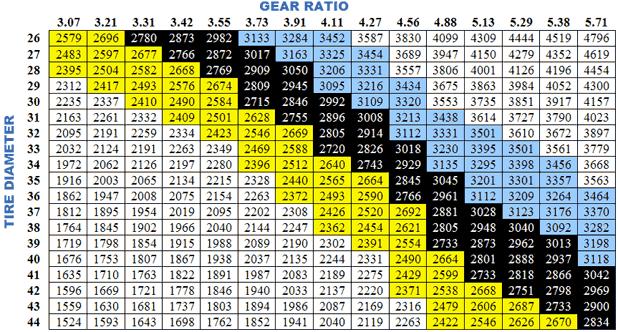
I'll try and oversimplify. Gear ratio is indicated by number, say 4.11 for example. This means for every 4.11 revolutions of the driveshaft, the wheel moves 1 revolution. Most stock Scramblers came with 2.73 to 3.54 ratios, and these were intended to be used with stock 28" tires. A bigger tire takes more force to move, so additional mechanical advantage is gained by regearing to a lower ratio. Just to be confusing, lower ratios are higher numbered- so a 4.11 is lower than a 2.73. Back to the mechanical advantage part. A lower gear has more mechanical advantage, just like a longer lever can move a greater weight. After installing bigger tires, performance can be regained by regearing to a lower gear set.
There is another way to look at the whole gearing equation- RPM change. If you change gears but don't change tires, lower gearing increases your RPM at any given speed, while higher gearing decreases your RPM at any given speed.
Another consideration- lower gears feel "peppier" in that they let the engine build revs sooner, but sometimes can give worse economy due to higher RPM's. Lower gears allow bigger tires, and make smaller engines feel more powerful.
Higher gears feel sluggish off the line, but can improve highway economy. Higher gears require smaller tires and bigger engines to be efficient.
A common formula:
3.73 = 31" tires
4.10 = 33" tires
4.56 = 35" tires.
Go to the next lower ratio for more power, the next higher ratio for better economy (only if you have the power.)
Stock Scramblers came with a Dana 30 front and an AMC 20 rear. Neither axle is a slouch, but neither is a pillar of strength either. The front 30 can be improved with alloy axles and do fine with 31-33" tires, 35" if you take it easy. The rear 20 really needs one piece aftermarket axles, and with them can handle 35".
Lockers are either selectable or automatic, or of the limited slip variety.
A Detroit is an automatic full locker- expect to hear and feel it in operation, and it may cause undesirable road manners especially in slippery conditions.
ARB, Ected, Elocker, ect are selectable lockers. Feel and operate like an open differential on the street, but hit a switch and they are fully locked.
Tru-Track, Trac Loc, Powr-Loc, Eaton Posi ect are limited slips. They minimize slippage without fully locking, and therefore have good street manners. Just remember, they're not full lockers and if one wheel is up in the air, it will want to spin.
For an agressive looking, capable 80% street 20% off road Scrambler, I'd recommend 33" tires, 4.10 gears, and a rear selectable locker. Probably a 3"-4" lift to clear the tires, and I'd want the 6 cyl. engine.
For a more stock looking Scrambler, go with 31" tires, 3.73 gears, a 2.5" lift, and probably a rear limited slip. I'd still recommend sticking with the 6 cyl. engine.
If you would like to experiment with the effects of changing gearing, tire size, transmission, ect, here is a website that is a "must have". You can plug in your transmission, transfer case, gear ratio, tire size, and compare a different setup beside it. It will show you RPM's in all gears, crawl ratio, ect. Check it out and have fun!
http://www.grimmjeeper.com/gears.html
And, here's a common chart to show tire size to gear ratio at 65 MPH, high gear, not in overdrive. Black highlited area is normal, yellow biases towards economy, blue biases towards torque/power.