

You are using an out of date browser. It may not display this or other websites correctly.
You should upgrade or use an alternative browser.
You should upgrade or use an alternative browser.
Brakes not working
- Thread starter Cobound
- Start date

- City
- Redmond
- State
- OR
Which linkages? Would the bind if they didnt before?
The linkage I've seen adjusted too tight is the pins on the relay bar between the pedal and the booster. This is on aftermarket boosters. Probably wouldn't get tighter with use, however.
- City
- Redmond
- State
- OR
Drum masters have a small residual pressure valve in the fluid port where the line screws in. You could either try and find a valve, or get an inline residual pressure valve. Drum brakes require a small amount of "holding" pressure to work right.I just realised I got a DIsc Disc master. Is there anyway to make this work with disc drum?
- City
- Redmond
- State
- OR
A well versed brake shop will know what you need.
1" master moves less fluid but has greater pressure, 1 1/8" moves more fluid but less pressure. But there's more to it than that...the master should be sized to the system requirements and pedal mechanical advantage.
Read this...
One area hot rodders, racers and custom car (and truck) builders tend to ignore is the brake master cylinder and, in particular, the actual brake pedal ratio. After all, it doesn’t make the car one bit quicker or faster, and if the thing eventually stops, why worry? Perhaps you should.
Pedal Ratio
The critical component in the braking equation is the pedal ratio. In operation, the brake pedal acts as a lever to increase the force the driver applies to the master cylinder. In turn, the master cylinder forces fluid to the disc brake caliper pistons or drum brake wheel cylinders. If you examine a brake pedal, you'll see the pivot point (where the pedal swivels) and the mounting point for the master cylinder pushrod are usually different. By varying the length of the pedal, and/or the distance between the pushrod mount and the pivot, you can change how much force (from your leg) is required to energize the master cylinder. This is the "mechanical advantage" or pedal ratio. This formula will help you figure it out: Input Force x Pedal Ratio ÷ Brake Piston Area = PSI.
Mathematical babble? The arithmetic simply equates to the amount of force exerted by your leg times the pedal ratio divided by the area of the brake piston(s). FYI, the typical adult male can exert roughly 300 pounds of force (maximum) with one leg—and that’s a bunch. Something in the order of 1/3 or 1/2 that figure is obviously more comfortable, even in a hardcore racecar.
The average manual (non-power boosted) master cylinder requires somewhere between 600-1,000 PSI to be totally effective. Somehow, 100-150 pounds of leg force has to be translated into 600-1,200 PSI. The way it's accomplished is by way of pedal ratio. While changing the overall length of the pedal is possible, it's often easier and far more practical to shorten the distance between the pivot point and the master cylinder pushrod mount location. That's precisely how many racecar chassis shops modify brake pedals.
Brake Line Pressure
Brake line pressure is a different thing than the force you apply to the pedal. Force acts in one direction and is addressed in pounds. Pressure acts in all directions against surrounding surfaces and is addressed in pounds per square inch or PSI. "Levers" (brake pedals) can be used to change the force. Inside the hydraulic system, the surface area of the piston is what is affected by pressure. Decreasing the bore size of the master cylinder increases the pressure it can build. Pistons in master cylinders are specified by bore size. But there's a hitch: The area of a circle (or bore) is Pi–R-Squared. The area of the piston surface increases or decreases as the square of the bore size or diameter. For example, the area of a common 1-1/8-inch master cylinder is approximately 0.994-inch. The area of an equally common 1.00-inch bore master cylinder is approximately 0.785-inch. Switching from the larger master cylinder to the smaller version will increase the line pressure approximately 26.5% assuming that pedal ratio hasn't changed.
As the pedal force or the pedal ratio (or both) is increased, the stroke of the master cylinder is shortened (brake line pressure is unaffected). When the size of the master cylinder piston increases, the output pressure of the master cylinder decreases. A smaller master cylinder piston will exert more line pressure with the same amount of force (pedal ratio) than a master cylinder piston with a larger piston area. There's another catch: Since the brake line fluid pressure is working against the surface of the wheel cylinder (or disc brake piston), increasing the area of the cylinder will increase brake torque.
Improved Braking
The bottom line is, if the stopping power of a car needs improvement, or if there’s a need to reduce the pedal effort, several options are available: (1) Decrease the master cylinder bore size; (2) Increase the pedal ratio; (3) Increase the wheel cylinder bore size. If the pedal ratio is increased, there will be more travel at the master cylinder piston. If the master cylinder bore size is decreased, the piston has to travel further to move the same amount of fluid. Typically, a master cylinder has approximately 1-1/2-inch to 1-3/4-inch of stroke (travel). The idea here is coordinate the pedal ratio with the bore size to arrive at approximately half of the stroke (roughly 1-inch) in order to make the brakes feel comfortable, and of course, to bring the car to a grinding halt.

Cobound
Legacy Registered User
- City
- Twin Cities
- State
- MN
Throw the original Jeep prop valve in the bin (trash to you) and just use the adjustable one in its place.
You will have to adjust it in to the correct setting by slowly adjusting it up (or down) and doing test runs up the road to find out if the front or rear locks up first and adjusting to suit.
Just hope that your master cylinder displaces enough fluid for the explorer calipers as well (i have no idea how big they are.)

This!
Although I'd recommend this valve- it takes the place of the original prop/distribution valve
http://www.jegs.com/i/JEGS/555/63025/10002/-1
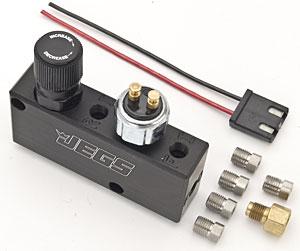
Bringing this back up, Jeep has sat for a while since I moved and so I haven't gotten around to doing anything to it. Well, now is the time...anyway...
Confirming, before I tear this apart...if I remove the stock proportioning valve and run my lines into this, both front and rear, this should give me a proper front brake and the ability to adjust the rear line...while the sensor runs the lights?
If that is the case, I can grab this, probably need to run new lines, and should solve my issues of the rear brakes not getting enough pressure?
Could it be that my master isn't pushing enough fluid to the rear, or is simply limited because of the current/stock proportion valve?
- City
- Redmond
- State
- OR
Short answer- yes. I ended up going from a 1" to a 1 1/8" master, and have a much better pedal, although I also have larger calipers/wheel cylinders. Yours may be limited by your current valve, or by a bad master. This is one of those situations where you usually end up replacing stuff until the problem is resolved.
Good luck, and Merry Christmas!
Good luck, and Merry Christmas!
Cobound
Legacy Registered User
- City
- Twin Cities
- State
- MN
Removed the stock pv, have an adjustable on rear lines with dedicated lines to front and rear, installed a mc from a Ram 2500, bigger piston diameter...instead of nose diving working off front only it now stops level, rears work...still a pretty soft pedal tho.
It stops, doesn't lock up, even when I hammer the pedal, pedal pressure increases when I pump the brakes. Soft pedal...should I live with that or can I increase the pedal pressure somehow?
Maybe I'm just really used to the new brake systems and the CJ is a notoriously soft pedal Jeep...at least it stops nicely...should I be happy w/ that?
Thanx,
B