You are using an out of date browser. It may not display this or other websites correctly.
You should upgrade or use an alternative browser.
You should upgrade or use an alternative browser.
Starter solenoid wire identification
- Thread starter CJocho
- Start date

- City
- Ducor
- State
- Ca
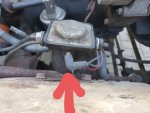
That’s a starter solenoid. And the arrow is pointed at the neutral safety switch terminal for an automatic transmission
- City
- Richmond
- State
- TX
Hard to tell from that photo if it is for an auto. If it is wired per the factory, you would only have a single ground wire to the “3rd” terminal. The fact there are 3 wires on that terminal is confusing.
Here is a stock auto solenoid:
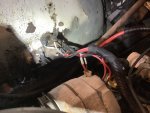
Blue wire is the start signal from the key.
Red wire is the coil resistor bypass (provides 12v to coil while starting)
Black wire on the bottom is the ground (comes from the transmission and provides a ground to the solenoid only if in neutral or park)
Here is a stock auto solenoid:
Blue wire is the start signal from the key.
Red wire is the coil resistor bypass (provides 12v to coil while starting)
Black wire on the bottom is the ground (comes from the transmission and provides a ground to the solenoid only if in neutral or park)
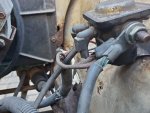
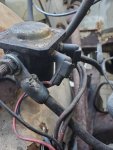
Ag4ever, I think the photo I previously uploaded had an optical illusion. The blue and red wires are in fact on the opposing side of the solenoid. That being said, I'm having trouble getting this Postal going. Here is what I have done so far:
1. New battery.
2. New starter.
3. New solenoid.
4. Stripped the sheathing from the ground wire (black wire in question) and wrapped it around "3rd" terminal. I can't seem to find that pig tail anywhere.
5. Reconnected the wires as pictured below.
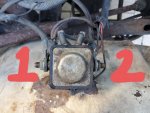
When I try to start her I get nothing. When I turn the key to the run position the starter makes no movement and I hear nothing at the starter solenoid. My neighbor, a man much more experienced in automotive mischief than I am came over to help me figure out the problem. He suggested we bypass the solenoid by connecting the opposing terminals (pictured as 1 and 2 in an attached image) that way we could get the starter going. Mind you, my main objective is to see if this engine runs. To complete this bypass my neighbor requested something metaIic that he could use that would bridge the gap. I gave him some channel locks with rubber handles I had on the work bench. He looked at me and said, "that should do." I went and turned the ignition and he made the connection via the channel locks. Sparks flew but the starter motor did nothing. I am at a loss of what's going on here. Any help would be much appreciated.
Oh yeah, one more thing. Any way I put the blue and red wire in the wrong spots? As I have installed it, the red wired is connected to the terminal closest to the grill, and the blue wire is connected to the terminal closes to the firewall. Thanks again for everyone's help.
Attachments

FLCJ8
Legacy Registered User
- City
- Palm Bay
- State
- FL
A few things:
With the transmission in Park you can take a set of jumper cables attach the ground cable from the battery ground post to the starter housing, attach the positive cable to the positive battery post (while the other end is safely clear of any metallic parts of the Jeep) and then touch the free end of the positive cable end to the post of the solenoid that leads to the starter.
If the battery and starter are good it should crank.
The engine will not start at this point without operating the key switch, but this is a simple test to narrow down your problem.
You may want to install a sacrificial nut on the the solenoid post and washer on the cable positive clamp to prevent damage from the arcing when touching the clamp to the post.
- Have you attempted to rotate the crankshaft of the engine to assure it isn't seized up?
- Are you sure that you have a good ground to the starter?
With the transmission in Park you can take a set of jumper cables attach the ground cable from the battery ground post to the starter housing, attach the positive cable to the positive battery post (while the other end is safely clear of any metallic parts of the Jeep) and then touch the free end of the positive cable end to the post of the solenoid that leads to the starter.
If the battery and starter are good it should crank.
The engine will not start at this point without operating the key switch, but this is a simple test to narrow down your problem.
You may want to install a sacrificial nut on the the solenoid post and washer on the cable positive clamp to prevent damage from the arcing when touching the clamp to the post.
- City
- Richmond
- State
- TX
From looking at the new pictures, it appears to be wired correctly.
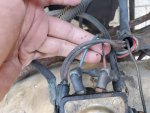
The “twin” wires you are holding go to the alternator and the fuse block power feed (provides power to the entire Jeep). The one feeding power to the Jeep is also a fusible link, so don’t replace this wire without some type of over current protection installed. Those two wires must be on the same terminal as the battery feed. The only wire on the other terminal is the starter feed.
To test the solenoid, you can ground the single terminal. But be sure the transmission is in park or neutral and even better have the Jeep raised and tires removed.
But, as FLCJ8 said, first check should be that the engine rotates. Sometimes this is as easy as grabbing the fan belt and pulling it to see if the crank rotates, and sometimes you need a ratchet on the crank bolt.
Let me know if you need pictures of anything. My overlander should be very similar to your postal setup.

He is correct on having the jeep in neutral or park and jumping across the solenoid (actually by passing the solenoid) will cause the starter motor to crank. If not you probably have a bad ground at the starter, froze motor, bad starter or more than likely bad battery/ground cables. If you have corrosion in the cables themselves. The corrosion causes resistance, not allowing the current to flow to the starter. It can be in any of the positive cables from the battery to solenoid to the starter as well as the ground cable (preventing the battery's ground to connect to the frame/engine. I had that happen on the cj7 to cj8 project. Went out and bought a battery and that didn't work (finally got my head out of my a**) and went back with a volt meter. Found the positive cable was corroded 2 inches from the battery clamp. Through a spare cable on and that was the end of it. You don't have to worry about the start and ignition connections to get the starter to turn. Another quick way is connect a heavy jumper from batt positive directly to the positive terminal on the starter (be careful not to touch to ground). That's the quick way to bypass everything. One other thing, you can use a voltage meter to check voltage at the starter while someone turns the key. You can have 12v at the starter and it not spin. The same resistance can reduce the current enough to not crank yet still have enough connection to show 12v at the starter.
FLCJ8, thanks for the info on the blue and red wire distinction. I just checked and you are correct that the solenoid has the "I" and "S" stamping.
I didn't have much time to work on it today but I did have time to see if I could manually turn over via the crank. Good news is that it turned very easily. I've never had to manually turn an engine over but this seemed to turn really smoothly via a rachet on the crank bolt.
As far as the ground situation mentioned by jammer1. FLCJ8, and ag4ever, that will have to wait till tomorrow evening when the kids go down. I'm very new to all of this and to be frank, I'm very lost when I hear check the ground. I have a multi meter and all I've ever used it for was to see if an outlet was hot. Looks like I'll be going to YouTube for some lessons. Any pictutes of the wires I should be checking would be much appreciated.
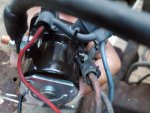
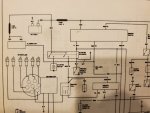
Lastly, I finally located my Chilton's manual. I've attached a picture of the wiring schematics for reference. If anyone can point out the ground wires I should be inspecting that would be great.
Attachments
A easy to make sure you have a ground to the engine is take a pair of battery jumpers. Use the jumper ground cable on the batt neg. post. Other end clip onto a starter motor bolt. You now by passed the ground cables and you know you have a temp ground to the engine.
Well this evening I finally got some time to work on this problem. I was able to get the starter to crank via FLCJ8's method with the jumper cables. It's good to know my brand new starter and battery work. I guess now I need to figure out why I'm not able to get it to crank via they ignition key. Could it be a possible problem with the mechanism that senses whether I'm in neutral or park? ( I can't think of the name of the part at the moment)
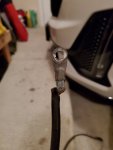
While I was trying to diagnose the problem I inspected the ground cable from the negative terminal of the battery to the engine block bolt connecting the power steering fluid resevoir. The cable looks a little oxidized. Could this be my problem?
While I was trying to diagnose the problem I inspected the ground cable from the negative terminal of the battery to the engine block bolt connecting the power steering fluid resevoir. The cable looks a little oxidized. Could this be my problem?
Attachments

- City
- East Norriton
- State
- PA
Corrosion could be it but I have seen worse work. Clean it and try it.
You can't think of the "neutral safety switch". Could be bad or gotten disconnected.
Possible bad fuse?
Broken wire in the column?
When you turn the key a small rod moves on top of the steering column, something get messed up there?
You can't think of the "neutral safety switch". Could be bad or gotten disconnected.
Possible bad fuse?
Broken wire in the column?
When you turn the key a small rod moves on top of the steering column, something get messed up there?
- City
- Richmond
- State
- TX
Next step is to check for voltage at the blue wire while cranking.
disconnect the blue wire and have someone use a multimeter (or a light probe) from the blue wire to a good ground. Then turn the key to start. If you get voltage, the issue is at the solenoid (relay). If no voltage, the issue is in the steering column or the wiring passthru block.
you can check the ground with a multimeter. While in park, there should be good continuity between the black wire and a good ground. While in reverse there should be no continuity. Neutral should be continuity and drive should be none.
So I just tested the blue wire by placing the positive probe of my multimeter into it. I then placed the negative probe onto the alternator housing. I set my multimeter to 2000m DC Voltage. When my wife turned the ignition (while holding our 1 year old -she's a very patient woman), the multimeter read 055. Is that enough juice to trigger the solenoid? If it is then I'm at a loss. That is a brand new starter solenoid. All I can think of now is a bad "neutral safety switch. Thoughts on how to proceed?
- City
- Richmond
- State
- TX
It should show a solid 12v (actually it should show approximately the same as the battery voltage).
On a 2000 millivolt scale, you should have seen around 13000 +/-. If all you saw was 055 that translates to 0.055 v or essentially nothing.
Try testing with the meter set to 20 (that is a 20 volt range, and you should see the same number as battery voltage).
Also, be sure it is not ignition on, but the key turned all the way to start (past the ignition on point). No harm will be done holding it there for an extended period as the wire to the solenoid is disconnected and the starter can’t be triggered.
I don't know if your ground cable goes from the batt to the starter bolt. If it does connect one end of the black jumper cable to the neg battery terminal, other end to the starter bolt. Disconnect the blue wire from the solenoid. Make sure the jeep is in neutral or park. Put the key in the on position. Make a 2 ft jumper wire, connect to pos terminal on the battery. Hold the other end in your hand (make sure it never touches ground). Touch the terminal on the solenoid that you removed the blue wire from. It should turn the motor on and start. Doing this you by passed the neutral safety switch, ignition switch (blue wire) and the jumper cable by passed the original black battery cable (not sure if you by passed this in earlier test). If this doesn't work make another jumper cable (like poss cable you did) and connect to batt neg terminal. Connect (or hold against) the solenoid metal body where ground attaches (while holding the poss jumper you made to where the blue wire terminal like above). Doing this you are making sure the solenoid is grounded and your still by passing everything mentioned above.
If on the first part it cranked (start or no start), pull the ground jumper cable from the starter motor bolt and try again. If it cranks you know the ground to the starter is ok. No start, the batt neg cable is bad.
If on the first part it cranked (start or no start), pull the ground jumper cable from the starter motor bolt and try again. If it cranks you know the ground to the starter is ok. No start, the batt neg cable is bad.
FLCJ8
Legacy Registered User
- City
- Palm Bay
- State
- FL
A couple basic troubleshooting tips:So I just tested the blue wire by placing the positive probe of my multimeter into it. I then placed the negative probe onto the alternator housing. I set my multimeter to 2000m DC Voltage. When my wife turned the ignition (while holding our 1 year old -she's a very patient woman), the multimeter read 055. Is that enough juice to trigger the solenoid? If it is then I'm at a loss. That is a brand new starter solenoid. All I can think of now is a bad "neutral safety switch. Thoughts on how to proceed?
- The 12 volts in the vehicle needs a complete path from the battery and back to the battery.
What this means is you are testing for a 12 volt positive output (such as the blue lead) then use the battery negative post for your negative return. If you are testing for a ground signal (such as the neutral safety switch lead to the solenoid) use the positive battery post for your 12 volt positive source. Of course this is based on a good battery, which we have already confirmed. - If using a multi-meter use the DC voltage setting that is just above your expected voltage.
Connect the negative (black) lead to the battery's negative post and the positive lead to the blue lead that was disconnected from the solenoid. As stated above... the ignition key needs to be turned and held to "START".
You should get a reading similar to your previous reference reading if the switch/wiring is good.
If you don't further testing will need to be done at the fuse block/ignition wiring.
Either way, I would suggest testing the neutral safety switch function.
Connect the meter's positive lead to the battery positive post, then connect the negative lead to the switch return wire that attaches to the solenoid.
You should get the reference voltage reading when the transmission is in PARK or NEUTRAL, and 0 volts in any other gear position.
If you don't get these results you can jumper the NSS post on the solenoid to the battery negative to simulate a good switch function.
Make sure the transmission is in PARK or NEUTRAL when doing any cranking tests with this bypass installed.
Time for dinner...
try these steps and report back
To begin, thank you so much to all of you who are helping me with this. This community has been beyond helpful. I'm sure my questions are very elementary and novice to you all. But to me, it's teaching me so much that I will hopefully carry on with me and someday teach my boys. But I digress.
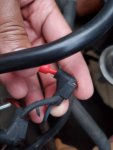
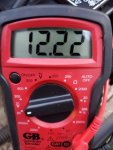
As suggested I first tested my battery by setting my multimeter to DC 20. At that setting I received a measurement of 12.22V for the car battery. I then tested the voltage of the blue switch by placing the positive lead into the blue wire lead as pictured, and the negative lead on the housing of the alternator (I believe this is a good ground). My wife then turned the key to the "START" position and held it there. While the ignition was held in the "START" position, the multimeter reading fluctuated between 0.01 and 0.02. I then switched my ground lead to the negative post of the battery (per FLCJ8's suggestion) and kept the positive lead from the multimeter to the blue wire. Once again, the ignition was held in the "START" position and once again, the multimeter reading fluctuated between. 0.01 and 0.02.
Based on the results of my test, it appears that I'm getting hardly no voltage to the solenoid via the blue wire. Am I understanding that correctly? If I am understanding that correctly, then I don't understand why sparks flew when my neighbor connected the channel locks to the opposing ends of the solenoid when we first tried to get the Postal running. Thoughts?
Tomorrow I'll get some readings on the Neutral Safety Switch as suggested by FLCJ8. If I have enough time I'll give the protocol recommended by Jammer1 a go. Ultimately my goal is to simply get this thing running so I can drive it to work and park it there while I finish up my other Scrambler at my home garage. I would just tow it to work but I need to be able to reliably get it started and moving in case my boss says "move that P.O.S. to the other end of the garage!"
Thanks again for everyone's help with this.
Attachments
FLCJ8
Legacy Registered User
- City
- Palm Bay
- State
- FL
The solenoid is basically an electrically controlled switch.Based on the results of my test, it appears that I'm getting hardly no voltage to the solenoid via the blue wire. Am I understanding that correctly? If I am understanding that correctly, then I don't understand why sparks flew when my neighbor connected the channel locks to the opposing ends of the solenoid when we first tried to get the Postal running. Thoughts?
The battery power is on one side and the starter load is on the other side, the blue wire from the ignition switch energizes the coil of the solenoid to close the "switch" connecting the battery to the starter. On a properly functioning system the connection between the two points is quick and internal of the solenoid. Your neighbor manually connected the two leads externally in a less controlled manner, hence the visible sparks.
After you test the NSS you will know if that is functioning properly.
If it isn't connect a ground jumper from the NSS post on the solenoid to the negative battery post, and attach another jumper from the "S" terminal. You can touch this jumper momentarily to the battery positive post. The solenoid should actuate and hopefully the engine will crank.
The engine won't start as the ignition needs input from the key switch, but this will narrow down your problem area(s), NSS, solenoid, ignition switch power/wiring.
Again... make sure the transmission is back in park or neutral after doing the NSS tests.
A couple basic troubleshooting tips:
In your case I would set the voltmeter for DC voltage just above the expected voltage and confirm that it is functioning properly by testing at both battery posts. This will confirm the leads are connected properly and also give you a reference point of the readings you are looking for.
- The 12 volts in the vehicle needs a complete path from the battery and back to the battery.
What this means is you are testing for a 12 volt positive output (such as the blue lead) then use the battery negative post for your negative return. If you are testing for a ground signal (such as the neutral safety switch lead to the solenoid) use the positive battery post for your 12 volt positive source. Of course this is based on a good battery, which we have already confirmed.- If using a multi-meter use the DC voltage setting that is just above your expected voltage.
Connect the negative (black) lead to the battery's negative post and the positive lead to the blue lead that was disconnected from the solenoid. As stated above... the ignition key needs to be turned and held to "START".
You should get a reading similar to your previous reference reading if the switch/wiring is good.
If you don't further testing will need to be done at the fuse block/ignition wiring.
Either way, I would suggest testing the neutral safety switch function.
Connect the meter's positive lead to the battery positive post, then connect the negative lead to the switch return wire that attaches to the solenoid.
You should get the reference voltage reading when the transmission is in PARK or NEUTRAL, and 0 volts in any other gear position.
If you don't get these results you can jumper the NSS post on the solenoid to the battery negative to simulate a good switch function.
Make sure the transmission is in PARK or NEUTRAL when doing any cranking tests with this bypass installed.
Time for dinner...
try these steps and report back
I tested the neutral safety switch function with the multimeter. The battery was reading 12.21V at the start of the test. With the car in PARK, I placed the multimeter positive lead (red) on the positive post of the battery, and then connected the negative lead (black) to the switch return wire as pictured. The reading I received on the multimeter was 1.9V with a precipitous drop as I held the lead onto the wire. I then placed the car in DRIVE, and received a reading of 0.42V.
With the car placed back in PARK, I connected a jumper cable from the neutral safety switch post of the solenoid to the negative post of the battery. I then went and turned the key to "START." The starter motor then cranked. Sooooooo.....does this mean I need to replace the neutral safety switch?