• Notice for iPhone users: DO NOT use the image size reduction option when uploading photos to the forum. This causes portrait images to post as landscape. We have added a warning to the image insert pop-up as well.

Project Panel Replacement

thin

aaaa.jpg

thick

bbbbb.jpg

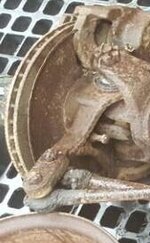
There is a lot more meat on the 1986 (and potentially the mentioned 1985's)... if you have that on a 1984, I have to think someone upgraded/swapped it on as that is much earlier than I had ever heard/seen. 1985 was a shock to me as I have seen many non-D44 setups in the rear (so later VIN) that had the thin setup in the front.

But I have no proof either way, just observations over the years.

cb
 
I can see the light at the end of the tunnel, but it is covered by more welding and grinding.
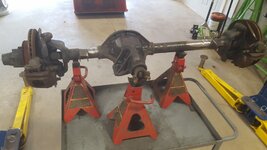
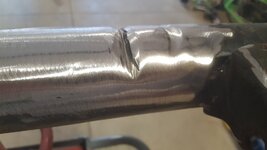
Got the SOA stuff off and flipped/rotated to clean out the gouging so I can weld it back.
The front was as bad (if not worse) than the front.

20220419_174451_resized.jpg

20220419_174458_resized.jpg

20220419_174504_resized.jpg

1650456633523.jpeg


One was a very deep cut... I just don't get why it had to be like this... take your time, it will come off.

Also, one of the spring perch mounts was almost cut through in half (no pic) and then used for the SOA setup with that much cut in half... so that was going to fail at some point would be my guess.

Crazy...

Anyway, slow and steady, getting about an hour per night to do this stuff, so I take what I can get.

cb
 
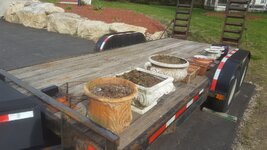
The reason for not picking up new Jeeps? Well... water/cold/freeze/thaw took a number on these guys... not sure exactly why, but this needs fixing.

20220507_140133_resized.jpg

cb
 
yeah... roughly 15 years old... brand new, I built it... seems installation should have had more of a gap between the boards for the freeze/thaw of New Hampshire winters... and some spacing between the joists to the composite decking for more ventilation... not sure I agree as the composite is de-laminating as well, but whatever it is/was, doesn't change the fact that it is almost Memorial Day weekend and I need to fix this.

cb
 
Somewhere around that era my sister had problems with her Trex or Trax I think it was composites. Got a refund on material, not labor.
 
Somewhere around that era my sister had problems with her Trex or Trax I think it was composites. Got a refund on material, not labor.
Yeah, the company we used seems to no longer be in business... this time around, we will go probably with a more long term provider.
We were told at the time this was the way to go, but I guess they learned a lot over the last 15 years.

cb
 
The reason for not picking up new Jeeps? Well... water/cold/freeze/thaw took a number on these guys... not sure exactly why, but this needs fixing.

View attachment 102533

cb
I've been researching adding onto our deck and have read a lot about sealing tape between the boards and joists.
Here's a link to one product that talks about the need for it. :shrug:
 
I've been researching adding onto our deck and have read a lot about sealing tape between the boards and joists.
Here's a link to one product that talks about the need for it. :shrug:
Yeah, we have seen that now... it seems like what we do on roofs with ice/water shield, but for deck to deck contact... I am sure it wouldn't hurt.
Sounds more like there needs to be a gap so you don't have wood sitting on wood directly for water/ice depending on the season and big enough gaps between the deck boards to allow for circulation.

We started with 3/16-ish between them, but they flattened somewhat and then squished together and no circulation.

cb
 
I had some issues with 10 year old treated wood… seems the formula was changed and does not last very long. I will add the tape, thanks for sharing
 
They removed the arsenic from treated wood in 1993. The pier and stairs/walkway that goes down the cliff to the river was built in 1991, same time as the house. Ground contact, stays wet, no maintenance - no rot or termites at all.

If I built the same thing today out of treated lumber it would not last 5 years.
 
This wood is probably pine. Washed up on the Mississippi River levee years ago and treated probably many years ago. Bottom is from a 16” X 16” X 25 ‘ beam. No rot at all and always in the weather. The top is also from the river. The previous treated 2 X 12 rotted out after about 5 years. 4D3DCF33-70F7-48C3-9FD9-7BF0840A5C01.jpeg
 
They removed the arsenic from treated wood in 1993. The pier and stairs/walkway that goes down the cliff to the river was built in 1991, same time as the house. Ground contact, stays wet, no maintenance - no rot or termites at all.

If I built the same thing today out of treated lumber it would not last 5 years.
You can still get the arsenic treated (CCA) wood in timber sizes. (At least you could a few years ago.) Can’t get it in dimensional sizes. Fear of it being used where kids can chew on it. You can thank 60 minutes for that one. Same reason the YJ was lower stock from the factory, 60 minutes expose on dangerous 4x4 vehicles.

There were a few years that the wood treatment process was really terrible. The chemicals used for treatment would rot any steel in direct contact. You had to use coated fasteners and hope there were no scratches in the coating, or use stainless.

I used Trex about 20 years ago to make a shade structure, boards were spaced about 2” apart. That composite wood is still in excellent shape. But it is about 10’ above ground in the SE Texas climate. It was all nominal 2x4 material. Heavy as heck when I installed it.

Other treatment types
CCA - Chromated Copper Arsenate (man, I miss that wood!)
MCQ - Micronized Copper Quaternary
MCA - Micronized Copper Azole (most common in Texas)
CA - Copper Azole (corrosive to uncoated fasteners)
ACQ - Alkaline Copper Quarternary (corrosive to uncoated fasteners)

For a deck structure, a wood with preservative rating UC4A is recommended. (Ground contact, higher preservative chemical levels.)

Good luck with the rebuild!

 
I wondered why the treated wood I used to build a duck blind 5-6 years ago didn't last very long.

Guess now I know. Typical nanny state govt BS resulting in a more expensive, less effective product.
 
Back
Top