• Notice for iPhone users: DO NOT use the image size reduction option when uploading photos to the forum. This causes portrait images to post as landscape. We have added a warning to the image insert pop-up as well.

spankrjs's Biloxi, MS '83 Scrambler

My @Kim Dawson aluminum front frame cover would not just drop back on after I added the third bolt to secure the top of the steering box bracket. Pretty close:

20231104_100647.jpg

In hindsight, after I drilled the third mounting hole in the cross member, I should have bolted the aluminum cover back on and marked it. I didn't think about it at the time. Kim added recesses for the two OEM bolts, up to you to add more if needed.

20231104_103619_HDR.jpg

I didn't feel like trying to put a recess in the cover, I didn't need much clearance. Since I drilled the third hole a tight 1/2" for a 7/16" bolt, I don't need a washer. To gain a bit more clearance, I substituted the Grade 8 hex head bolt for a 7/16" allan head bolt. It is not quite Grade 8 equivalent, but pretty close.

20231104_103651_HDR.jpg

And installed. Gave me just enough clearance:

20231104_103635_HDR.jpg


20231104_103642_HDR.jpg

Forgot to take a picture, but after a little filing on the driver side rear mounting hole, the aluminum cross member cover dropped right on and bolted into place with no drama.

Took this Scrambler for about a 5 hour back roads drive today, steering is great, no leaks, good to go!!

That's it for now :wave:
 
My red Scrambler is down, but I told Andy I would help him work on his Jeep today over in New Orleans, so took the spare Scrambler out!!

20240608_082901_HDR.jpg

It is running and driving great, drove it 70mph to New Orleans and back (about 200 miles total) no issues.

20240608_082912_HDR.jpg

20240608_085848_HDR.jpg

Andy broke the rear brake hard line, the one that runs from the proportioning valve back to the rear flex line, while changing said flexible line. We got the old line off, new line on, new flex line, two new short axle mounted hard lines, and new hardware, shoes, and wheel cylinders on both rear axle sides. But, no fluid flow to the rear, barely anything. Long story short, new master cylinder fixed his issue, hope I fix my red Scrambler problems tomorrow.

IF I can't get the red Scrambler fixed before the National event in Hot Springs I am confident old spare Scrambler is ready!!
 
Thanks Raymond ! I couldn’t have done it without you. You’re one heck of a friend. :cheers: It is a long story and was a long day. Sure glad I had a garage with ac window unit.
 
My red Scrambler is down, but I told Andy I would help him work on his Jeep today over in New Orleans, so took the spare Scrambler out!!


It is running and driving great, drove it 70mph to New Orleans and back (about 200 miles total) no issues.

View attachment 113897


Does that one have a T5 trans or just the knob?
 
I rebuilt the original T5 a few years ago. The OEM counter gear had wear on one of the ends wear the roller bearing rollers ride directly on the shaft. Besides this damage it was good. The case was in great shape, the front and rear counter shaft/main shaft bearing bores were all tight. If the T5's I put in my red Scrambler had cases this tight they might have held up. The smaller tires (31" vs red 33") and the higher rear end gear (3.31 vs 4.10) I think help this one's survival greatly, too :fingerscrossed:
 
Drove this one a bunch earlier this year when I was working on the red Scrambler. It has been running fine, but it still had that annoying/slight tire/wheel vibration once over 50mph. Had the tires/wheels rebalanced this morning, a little bit better, but still not happy. Found a tire shop with an operable Hunter Road Force balancing machine, and a technician willing to mount and remount the tires to the wheels as many times as necessary. Finally, success, no more vibration!!

20250901_165147.jpg

This has been a major PIA. I think I got used to it, but after putting new tires on the red Scrambler, which are mud tires on bent up wheels, with no vibrations, this ones annoying vibration came back to bug me. Anyway, fixed now, finally!!
 
Time for the yearly oil change on this one, and it actually had 3k miles on it since last year. With the annoying vibration gone I've been driving it more and more.

20260315_135439.jpg

Greased everything up and did a general welfare check on everything. Good to go, except now the rear pinion has a bit of vertical/side to side movement. Not a lot, maybe 1/16". No weird noises, no leaking pinion seal, no in out play. But, need to address this.

I might just try a "quick and dirty " on this, i.e. just change the outer bearing, race and seal. Easier to do this before I have to remove both axle shafts/differential to completely remove the pinion to replace the inner bearing. The larger inner bearing usually last much longer.

Will probably just change the outer bearing for now, unless I notice some serious damage, which I doubt. If I have to pull the pinion this might snowball into a front and rear ring and pinion swap!! The 3.31's/T5/and 31's work great but I would like a bit more gear, at least 3.54, maybe 3.73. We will see.

That's it for now.
 
Quick maintenance summary for my own benefit.

April 2009, 116k miles - purchased

May 2012, mileage not noted - Moser one piece axles installed

December 2012, 120k miles - general mileage note

January to September 2017, mileage not noted - engine rebuilt by Hesco, Mopar MPI added, rebuilt T5 and Dana 300, new clutch and associated parts, new in tank fuel pump and all fuel supply and vent lines

January 2018, mileage not noted - replaced all three original rubber brake lines

August 2018, mileage not noted - Jeep Air AC kit installed

October 2018, mileage not noted - BDS YJ suspension conversion installed, 2" YJ lift springs, all new shocks and bushings

December 2018, mileage not noted - new front and rear driveshafts installed, rear CV shaft

April 2019, mileage not noted - refurbished OEM 8" chrome wheels, new 31" BFG tires

July 2020, mileage not noted - AC belt modifications (idler pulley and tensioner bolt)

January 2021, mileage not noted - aftermarket carpet installed

July 2021, mileage not noted - front wheel bearings and brakes replaced, new rotors, new spindle bearings and seals, new front axle u-joints installed, Superwinch front lock in hubs installed

August 2021, mileage not noted - Kim Dawson rear bumper cast aluminum end caps installed

September 2021, mileage not noted - modified OEM carburetor air cleaner to work with MPI (grill modification needed)

October 2021, mileage not noted - TNT rear tire carrier installed

December 2021, mileage not noted - T5 fluid drained and replaced with Pennzoil Syncromesh, Real Gasket valve cover gasket installed

March 2022, mileage not noted - Kim Dawson cast aluminum front frame cover installed

January 2023, mileage not noted - T5 fluid drained and replaced with Royal Purple, installed new pilot bushing, changed T5 back to Valvoline MTF

February 2023, mileage not noted - AMC 20 diff cover gasket and new fluid installed, Borgeson steering shaft installed, Wolff lower steering column bearing installed, new heater core and correct heater hoses installed

September 2023, mileage not noted - new AC belt, again

October 2023, mileage not noted -rebuilt PS box and pump installed, M.O.R.E. steering box bracket and brace installed

March 3, 2024, 134,090 miles - engine oil and filter changed, greased driveshafts, suspension, steering, clutch linkage, all fluid checked

March 8, 2025, 135,169 miles - engine oil and filter changed, greased driveshafts, suspension, steering, clutch linkage, all fluid checked

September 2025, mileage not noted - tire vibration finally gone after yet another tire/wheel balance job

March 15, 2026, 138,070 miles - engine oil and filter changed, greased driveshafts, suspension, steering, clutch linkage, all fluid checked

April 2026, 138,075 miles - new rear differential carrier bearings, pinion bearings and seal and crush sleeve, new rear yoke, new bearings and seals installed on Moser axles, new inner axle oil seals, all new rear brake pads and components, all new frame/axle mounted SS brake lines installed, new brake flex lines installed, LSD additive
 
Last edited:
Quick history lesson. I purchased this Scrambler back around April 2009, about 116k miles on it. It had a pretty good rear pinion oil seal leak. Way back in 2009 I took it to my ring and pinion/driveshaft guy to install a new pinion seal. He installed a new seal but also advised me the bearings felt a hair looser then what he liked. Fast forward to today, April 2026 and 138k miles, time to address these bearings.

Back in 2012 I attempted to install new bearing and seals on the original 2 piece axles. This failed due to excessive wear on the differential centering block, allowing the OEM axles to plunge inward slightly, causing the outer axle seals to leak. I ruined one rear axle hub trying to disassemble the OEM axles a second time so I switched to Moser one piece axles. I had to pull the differential out to remove the centering block to install the Moser axles, so not my first time in here. Pretty sure no one else ever went in this rear axle. When I installed the Moser axles/reinstalled the differential carrier, the pinion and carrier bearings felt OK to me, no play I could feel. And everything was lovely, and still was, until the other day.

With the rear driveshaft connected to the pinion I could feel very minimal up/down and side to side movement. There should be none. With the driveshaft disconnected I could move the pinion in and out a couple thousandths. Not what you want at all. If you just let this go it will not just magically fix itself, so here we go!!

Started taking things apart the other night.

20260331_193043.jpg


Keeping things organized by side.

20260331_193057.jpg


Removed both axle shafts this afternoon. Whatever sealant I used back then did not stick too well to anything, no bearing contamination luckily. Should make clean up easier.

Passenger side.

20260403_142200.jpg

20260403_142203.jpg


Driver side.

20260403_142452.jpg

20260403_142456.jpg

Even though these outer axle shaft bearings are "one piece" don't be surprised if the outer races stay in the axle housing ends. They are not broken and will go back together. A bit easier to regrease this way.

I have new Moser bearings and seals on hand, but these bearings still feel fine, and the seals are not leaking. Since the bearings and seals only have about 20k miles on them I am going to reuse these parts. I usually get about 50k miles out of this setup before an axle seal starts leaking necessitating bearing destruction for seal replacement so I am going to rock it for now. I can revisit this in the future with a Warn Full float axle kit if need be, or just new Moser bearings and seals.

Put plastic bags over the bearings to keep crud out.

20260403_143248.jpg
 
Even with the pinion a hair loose (only loose if you pull on it) I wanted to check the ring and pinion back lash, for a base line. So, generally, if you are only changing bearings, the original shims should be fine. But, never hurts to check.

What the FSM says, 5-10 with 8 thousandths preferred.

20260403_144949.jpg

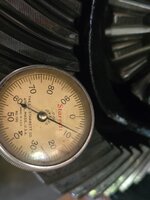
Setting up the dial indicator.

20260403_145001.jpg

I'm at about 7 thousandths so good enough.

20260403_145013.jpg

Four big bolts and the differential comes out. Make sure to keep the bearing journals AND shims on their correct sides!!

20260403_150103.jpg

Generally a bitch to remove the pinion. The FSM says to use a rawhide hammer to drive the pinion out but I've never seen that happen. I left the yoke nut on the pinion threads to protect them, then used some metric headed bolt that fit inside the nut, 2 pound hammer with lots of steady whacks, finished up with a sand filled hammer. You are basically knocking the pinion out of the outer bearings inner race that becomes pressed on when you assemble all this stuff.

20260403_160330.jpg

20260403_160338.jpg

I kept a box behind the axle to catch the pinion if need be, but it really won't go flying out unless you are just being stupid with the hammer. Once it's almost out you will know, it's not like it's just going to go flying out. Regardless, you don't want the pinion to hit the ground and potentially damage the teeth.
 
Started cleaning parts.

Make sure you keep these on the correct sides!!!

20260403_190309.jpg

Axle housing cleaned.

20260403_190318.jpg

Round one cleaning complete on these parts. Will finalize cleaning and inspection once more disassembly is completed on these components.

20260403_190339.jpg

And new parts.

20260403_190349.jpg

New differential carrier and pinion bearings, pinion nut and seal, yoke, collapsible spacer, LSD clutch packs, and LSD additive.

This Scrambler has the OEM Trac-Lok limited slip differential, 3.31 ring and pinion. With 138k miles I figured it might be worth replacing the clutch packs. This is nowhere near a locking differential for hard core performance, but a nice upgrade that works OK with stock/smaller tires. I actually took all this apart way back when to remove the centering block, so vaguely remember the process and PIA factor.

Only damage found so far.

I slightly chipped up the shim that sits behind the inner pinion bearing race. I was using a punch to knock the race out, forgot about this shim, so it kept slipping in the way of the punch. Not terribly concerned about this. I will file down the sharp edges and make sure no chunks are gonna fall off. This shim does not turn and is sandwiched in place between part of the axle housing and the bearing race. It only acts as a spacer to set pinion depth. I'll check and see if I have another new shim, but doubtful.

20260403_190431.jpg

Pretty sure this differential is exactly as it came from the factory. One way to tell is by the shims - the OEM set ups typically will have a single shim at each location, not a stack of different sized shims. This pinion shim and both carrier shim stacks are this way, one shim at each location.

Yoke has very minor shadow/marks where the seal rides. I could clean it up or replace it.

20260403_190448.jpg

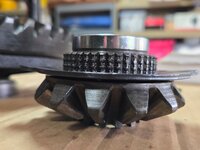
Hard to picture, but very back edge of each pinion tooth has a tiny shard/sharp little tit. Not concerned about this, probably normal from all the miles. This rear end was quiet and tight, even with loose pinion bearings, so rock and roll.

20260403_190546.jpg

Just a quick look, but all the teeth on the differential gears look good. I will know more once I pull all this stuff out to replace the clutch packs. But hopefully won't need any new parts here. If so, I will go used OEM vs Crown.

20260403_190505.jpg

Just a quick picture, used collapsible spacer on the left, new on the right. I'll talk more about this part later on.

20260403_190624.jpg

Will get back on this horse tomorrow, that's it for now.
 
Got some more work completed today. Started on disassembling the Trac Lok.

Two clips on this shaft, two screwdrivers and a hammer will take them off. Be careful, they will go flying off!!

20260404_090758.jpg

20260404_090807.jpg

With a 3.31 ratio I did not have to remove the ring gear from the carrier, the cross shaft easily clears the teeth. You can remove the ring gear if you want, makes the whole assembly a bit lighter and less off balanced. I left it on, no problems.

20260404_091019.jpg

First clue this limited slip is wore out: I was able to turn the spider gears/side gears around by hand inside the case. Well, I should say second clue. First clue would have been when the differential/axle shafts were still installed, I was turning one axle shaft and the other was turning the opposite direction just like an open differential.

20260404_091227.jpg

Since these internals had so much wear, I was able to simply remove the spider gears by hand, then the side gears simply fell out, too. If the unit is still in good shape you will have to compress the Bellevue springs in order the take this stuff apart.

20260404_091553.jpg

20260404_091602.jpg


One side gear/clutch pack, retainer clips.

20260404_091746.jpg

All the components, minus the clutch packs.

20260404_094426.jpg

Clutch packs.

20260404_094430.jpg

Minor wear marks inside these old retainer clips.

20260404_094445.jpg
 
Cleaning and inspecting parts.

Back sides of spider gears and thrust washers look and feel fine, no scratches, gouges, etc.

20260404_094437.jpg

All these little teeth on the back side of the side gears look good.

20260404_094452.jpg

None of the clutch discs were burnt or cracked.

20260404_094459.jpg

But, if you look closely, the little teeth that are supposed to be around the edge of the discs are gone. Disc on left has no teeth, disc on right still has teeth.

20260404_094515.jpg

There are two types of disc's, one has little side tits that slide into the retainer clips and the other has no side tits. Almost all of my old disc's had no teeth left.

New clutch packs and retainer clips.

20260404_094727.jpg

You can see all the little teeth on the inside of the new discs. Also, the two types of disc's have different groove patterns.

20260404_094744.jpg

New clutch pack on the left, old pack on the right. Note the stack orientation.

20260404_095810.jpg

Besides all the missing teeth off the old clutch packs, the other major wear issue was the original Bellevue springs that go between the side gears and the clutch packs. My original 40 year old Bellvue springs lost tension. You can see the bevel on this new Bellvue spring.

20260404_095818.jpg

20260404_100624.jpg
 
The Bellevue spring goes on the side gear first, bevel facing the differential case side.

20260404_100633.jpg

The two types of disc's. They just stack up on top of the Bellevue washers in an alternating pattern.

20260404_100548.jpg

Picture from the FSM.

20260404_100800.jpg

New Bellville washer and clutch stack on left, old stuff on right. You can see how new stack on left protrudes higher then the side gear teeth, compared to right stack height. My old stuff was obviously not putting much tension on the differential case, hence no limited slip affect.

20260404_100401.jpg

The two sides gear clutch packs assembled. I wiped lube on the face of all the disc's and Bellvue washers, thick grease is holding the clips on.

20260404_102346.jpg

One side gear installed back into the differential case. NOTE: the opening on one side of the case is a little bigger then the other side, a little bit easier to use the larger opening.

20260404_104603.jpg

Make sure the clips went in their holes.

20260404_104607.jpg
 
Alright, now the fun part. The FSM references special tools that don't exist to reassemble all this stuff inside the differential case. The FSM is of no use. I watched a video from IIRC Yukon or Randy's Ring and Pinion, a bit better, but they also use special tools. I watched a 30 minute video on YouTube and also learned what not to do. So, this is what I did, worked fine. BUT you must be in a patient mood.

One side gear in the case, bottom side. I installed the other side gear into the top of the case, then held it in place with a piece of 1/2" fine thread rod/nuts/washers. I just tightened this rod up snug with a 1/2" ratchet with differential case sitting loose on the bench, so not super tight. I did NOT clamp the other side gear at all. This is important. With only one side gear clamped, I inserted both side gears into place WITHOUT their corresponding thrust washers. I then walked over to where I have one of the axles sticking up vertically. Sat the differential onto the axle splines inside the bottom side gear. I then pushed/rolled the side gears into position.

20260404_113118.jpg

20260404_113123.jpg

Now, that is all fine and dandy, but I still need to install the thrust washers behind the spider gears. What I did, gently kept tightening up or loosening my threaded rod until I got enough clearance to install the thrust washers behind the spider gears. Lots of lube, patience. I did NOT have to force anything or smack anything with a hammer. Patience.

20260404_113612.jpg

20260404_114513.jpg

Great, everything is in place. BUT, everything is not lined up correctly with regards to the cross shaft bore holes.

20260404_114517.jpg

20260404_114522.jpg

No problem. Reinstall the threaded rod, adjust the tension as needed, use your fingers to push the spider gears/thrust washers into place. Then, use the cross shaft to ensure each spider gear/washer is in the correct spot. Once the shaft will go through either side, remove the threaded rod. Nothing will move out of place. Carefully install the cross shaft and gently tap in all the way though the differential case. Should tap in easy. That's it.

Holes aligned perfectly.

20260404_114610.jpg

Shaft goes right in, then tap on the little PIA clips that will go flying off into space if you are not careful. Finished.

20260404_121851.jpg

That's how I did it, seemed to work great, no drama, not too much cussing. That 30 minute video I saw was terrible. The guy was forcing the gears into position with a punch and hammer, hammering on the teeth of the gears. I would advise NOT to do that!!! I think the trick is to just gently compress one side and one side only. If you do this, you can roll/spin the other three gears around into position by hand. If you compress both sides gears you can NOT roll/turn/push the gears into position since both side gears will be locked onto the case and will not turn independent of each other. My .02 cents.

One last picture of the differential, the OEM centering block that is used with the OEM two piece axles. I had to remove this when I originally installed the Moser axles. Keep in mind, if you have a Trac Lok and want to install Moser axles you will most probably have to remove this piece. You won't have to take all the clutch parts apart if you are careful.

20260404_121854.jpg

Differential internal assembly complete.
 
Used my large two jaw puller and bearing splitter, removed both old differential carrier bearings.

20260404_130621.jpg

Kind of neat how the part number from the original bearing was etched into the side of the carrier!

20260404_134023.jpg

Unfortunately my two jaw puller is not long enough to remove the inner pinion bearing, won't reach deep enough. In the past I would just cut this bearing off with the Dremel/drill/chisel. Works, but PIA. Since I seem to run across this issue from time to time I went and bought a deep reach puller from Harbor Freight. They seem to be the only store that carries anything like this. Probably not the best quality but it worked perfectly for me, and now I have this tool if I ever need it again.

20260404_145201.jpg

20260404_145207.jpg

Worked perfect.

20260404_150016.jpg

20260404_150617.jpg

I used my caliper to compare the height of the new bearings vs old bearings. The inner pinion bearing and differential carrier bearings are identical. The new outer pinion bearing was a hair taller then the old one, no problem here due to the collapsible spacer, more on this later.

20260404_151340.jpg

Pressing the new inner pinion bearing on.

20260404_152758.jpg

Set aside for now with the race over the bearing.

20260404_153608.jpg

I filed and cleaned up the pinion depth spacer that I slightly damaged during removal. No cracks,not bent, just chipped up the ID a hair. Will not affect anything so rock and roll.

20260404_153616.jpg
 
Pressing the new differential carrier bearings on.

20260404_155259.jpg

20260404_155853.jpg

Keeping the races correctly oriented. Probably does not matter since both bearings are identical and new, but good practice.

20260404_160637.jpg

Finally feel like I'm getting somewhere, two subassemblies ready to go.

20260404_160641.jpg

My box of press tools. Mostly old bearing inner races that I honed out to slip fit over things. For the above operation I have an old AMC 20 diff carrier bearing inner cage and inner pinion bearing inner cage. Both honed out so they will slip over the corresponding shaft/journals. Amazingly what you accumulate over time.

20260404_160646.jpg

Picture of the collapsible spacer on the pinion shaft.

20260404_173735.jpg

The outer pinion bearing goes on like so. When this assembly is installed into the axle housing, the driveshaft yoke will press the outer pinion bearing on to the pinion shaft when you tighten the yoke nut. You will force the outer pinion bearing down the shaft until it hits the collapsible spacer. This is what sets the preload on these two bearings. The trick is to not collapse this spacer too much!

20260404_161355.jpg

This is why I was not too concerned about the new outer pinion bearing being a hair thicker then the original bearing. The collapsible spacer will compensate for this.

Installing the inner pinion bearing race into the axle housing. The depth shim is behind this race.

20260404_172024.jpg

When I installed this race, the spacer shim wants to slide down and will be visible in the ID of the race. So, gently tapped it back out a hair, pushed the shim back up, and re-drove the race home. Now you can't see the depth shim behind the race, and more importantly, it will not foul on the inner bearing.

20260404_172024.jpg

Outer pinion bearing race installed.

20260404_173219.jpg

Now the fun part. Laying on the ground on the yoke side of the rear axle, I reach under and into the axle housing to hold the pinion in place. Then, slide the new outer pinion bearing into place while holding the pinion in the correct orientation. Then, I installed the old yoke on the pinion splines, then the old pinion nut. I tightened the old nut with an impact while holding the pinion in place. I tightened the old yoke/nut up until almost all the end play from the pinion was gone. So, now the outer pinion bearing is almost pushed all the way down on to the collapsible spacer.

20260404_180541.jpg
 
At this point I stop, remove the old yoke and nut. The pinion will NOT fall out of the axle housing because the outer bearing is now pressed into place. I installed the new pinion oil seal now that the pinion is installed.

20260404_183453.jpg

Stopped here for the day. The next part is the most fiddly - tightening up the new yoke/nut onto the pinion shaft and setting the pinion bearing preload.

That's it for now.
 
Back
Top