• Notice for iPhone users: DO NOT use the image size reduction option when uploading photos to the forum. This causes portrait images to post as landscape. We have added a warning to the image insert pop-up as well.

Torqueflite 999 rebuild

Once the bottom is assembled, time to address the tail housing. This transmission did not have a tail housing when I acquired it, I sourced a replacement on flea bay some time ago. It is the one where I sand blasted it and reassembled the parking pawl. Only issue is the missing bolts that hold the tail housing to the main case. So, I bought these at the local auto parts house. 3/8” - 16 x 1 - 1/4”

13462933-B8F7-4845-A225-C56D753FD36B.jpeg

I used aviation sealant to coat the paper tail housing gasket, placed the rear support bearing on the tail shaft, placed the gasket on the main case, then gently pressed the tail housing down on the case while guiding the park lever shaft into the pawl pocket.

E3468EB3-7E24-4761-A07D-FC343BD85AE1.jpeg C1441291-B9FD-4EFC-89F6-74FED9F857E0.jpeg

After tightening the bolts to ~about 150-175 inch-pounds I turned to the kick down band adjustment. This required a square head socket 5/16“. I used an 8 point socket. Tighten it to 72 inch-pounds, then loosen it 2 1/2 turns. Tighten the jamb nut.

86A2C8ED-B2F5-4590-8B77-94AE8A4291D0.jpeg 959D304A-952A-4E99-9F8C-3F1DF7018476.jpeg

Internal band adjustment = 72 in-lb - 4 turns

External band adjustment = 72 in-lb - 2.5 turns
 
Before installing the shift lever, be sure to add a washer and e-clip on the throttle valve shaft. I missed this step in the books but it is VERY critical. If you don’t do this, there is enough up and down play that the detent ball will jump out from under the rooster comb and roll around in the pan. Also, the insulator for the neutral safety switch can break due to the slop. (Don’t ask me how I know this!). I used a 5/16” stainless steel washer and a 1/4” e-clip.

31875DC0-57BC-4FA5-A97E-6ADE93B8F688.jpeg

Now install the shift lever and tighten the nut to clamp it on the large shaft.

81A1D10D-2F7B-45F3-B88F-F34B774708B0.jpeg

Next up is the throttle valve lever. Slide it down the shaft till it bottoms out, then tighten the nut.

542FDE69-3466-489A-BDD0-E317BAD42BFD.jpeg

There you have it, a bench rebuilt A999 3 speed transmission for a mid-80’s Jeep CJ. (Less a dipstick tube that will be installed during the vehicle installation.)

07F4A62D-C3ED-4736-8A8B-6F749F0AAB11.jpeg

I plan to pick up my new torque converter tomorrow, so if the weather cooperates, I hope to pull the old transmission and install this one this weekend. 🤞

:wave:
 
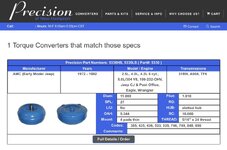
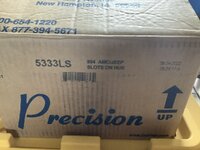
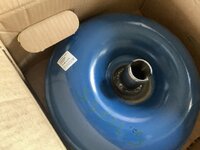
Picked up my remanufactured torque converter. Precision of New Hampton Model 5333LS.

Here are the other choices for our a999 transmissions:

1D2751D8-E7A3-44AB-B61F-9072C6EED88B.jpeg F0DD2A60-EC63-427A-825E-46365FFFFA12.jpeg 0C5E3E79-5023-4494-8413-BAF1675AC16E.jpeg 71B8F5E2-389B-45E3-A368-4937A6FD05B2.jpeg

Now I just need clear weather to install. Current forecast is rain for the next few weeks is seems.
 
Last edited:
Started the install process (really the removal process). First supported the transmission with my 20ish year old HF transmission scissor jack. Then remove the transmission mount bolts (torque are bolts) and the skid plate bolts. Once that is dropped, remove the front and rear driveshaft. Then clean the years old accumulated oil and dirt concoction off the transfer case. Remove the transmission mount from the transmission. When I dropped the front drive shaft one of the cups popped off the u-joint. Some of the needle bearing were lost in the dirt pile. Guess I will be replacing u-joints now as part of this process. Oh well, they are probably 20+ years old and probably have not been serviced in that timeframe. Heck, they might be original, who knows. :shrug:

098DDD78-6457-4E18-87C0-013E0C45DF95.jpeg F6CA3A1B-2767-4674-8CBF-0D5F4FA6505A.jpeg 66D03BD6-850F-4C1E-BCA6-56DBF3F60AB2.jpeg A4A17957-7C48-42DF-B75B-6AB11DDE1C9D.jpeg

I have started embracing the labeled baggie method of hardware sorting. As I age, CRS gets stronger and stronger.
 
Finally got the crusty old transfer case out. Thing was glued on the transmission. I don’t recall D300’s weighing that much. Either I am getting older or they are getting heavier. I’m blaming the 25 lbs of dirt on it.

C215420C-F52F-4C7A-9714-E6FBD4124661.jpeg
 
Quick date with the 4,000 PSI water hose and the transfer case & skid plate are ready for some degreaser then the good old fashioned rattle can rebuild.

DBEA4069-9450-45C2-917B-B1767CF975D8.jpeg 110E9886-7020-43E4-A8AB-49EBBFA788F2.jpeg

Interestingly, I placed a tailhousing from a spare transmission on the transfer case to protect the input shaft and internals from water. It had a stainless steel transmission mount on it. I don’t think AMC offered this as an option, but who knows.

BCEA40B2-7F39-4FCE-B929-293EDB7A9D98.jpeg
 
Old transmission Is out.

04CF8A5D-3C6E-4FEA-BEDD-FC5851E372AD.jpeg F7E310A3-0122-4296-A0E9-2F1F17FC4E82.jpeg

I have steam cleaned the transfer case. Just waiting on some dry weather to paint the transfer case and skid plate.

Also need to back flush the cooler lines. Then reinstall all the parts removed.
 
Been cleaning the fasteners in an ultrasonic cleaner in Simple Green solution.

8DE3B4EE-BC1F-4827-8186-DD6D2AB76FB9.jpeg 8148FE7B-14F4-4DB5-BAFE-6EA0B527D064.jpeg

It was finally dry enough (but still 99% humidity) to throw a couple coats of paint on the skid and Transfer Case. I decided to not paint the aluminum parts, shifter linkage, and output yokes.

C06E53BE-6140-4DDC-820B-0CF2313EF5C8.jpeg 2360BDFD-B150-4027-A3F3-A36DC905C678.jpeg

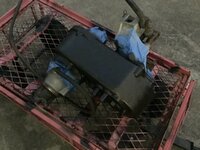
Don’t laugh at my hillbilly paint cart. Works great to keep the parts out of the grass and allows me to paint away from anything that could be tagged by the overspray. Also, a cast iron transfer case is stupid heavy.
 
Installation time. First up is getting the transmission under the Jeep. The bellhousing is too tall to slid under the frame, so I jacked up the right front axle under the spring a couple inches. This allows enough space to slide the transmission on the floor and under the body. Then it is time to lift the transmission onto the jack. As my body matures, I find I can no longer bench press an automatic transmission up and onto a jack. So, I tilted it on the bellhousing and slid the jack under the pan. With some help from my deer wife (on Mother’s Day) it was successfully resting on the jack. I then filled the torque converter with a couple quarts of fluid and then slid it onto the input shaft. Note that the transmission is WAY TOO HEAVY to lift or move when the torque converter is installed. I chose Valvoline Maxlife Multi-Vehicle formula. This is a Dex/Merc formula.

53C89583-7513-4298-9FB2-468A688EC6FA.jpeg

There is a lot of debate on what type of fluid to use. The original formula is no longer available. The ‘82 service manual calls for “Jeep, Dexron, or equivalent atf.” Tom Hand‘s book calls for, “Dexron, Type 7176 or equivalent.” ATSG manual calls for, “Dexron II type ATF.” The 1988 Chrysler Fundamentals of Automatic Transmissions describes 3 types of fluids. “Type ‘A’ is obsolete” and is predecessor to “Dexron / Dexron II - these are ‘very slippery’, low detergent, multi-purpose, non-variable viscosity (low), high heat durability, excellent cooling.” Next is “Type ‘F’ or Ford fluid”. Very sticky, moderate lubricating, moderate cooling, fast clutch application, no friction modifiers. This manual recommends Dexron II. The Carl Monroe book basically says, “all fluids are compatible, use type F for race applications, Dexron for non-lockup, and ATF+4 for lockup applications.” I have also read internet suggestions to sub one quart of ATF for a quart of motor oil. I think I am just sticking with straight dex/merc. Given the old tech of the a999, I imagine only the new friction materials in the clutches and converter really care what type of atf is used. The selected atf is a synthetic, so it should have good heat tolerance properties. Time will tell.

Now that the torque converter is fully seated (it must be well recessed past the face of the bellhousing, forcing it in can break the pump) it is time to raise the transmission into place. Shimmy, jostle, shake, and Gide it into place on the 2 dowels in the engine. Ther are large size bolts at 9 and 3. Medium size bolts that pass thru the engine flange and have nuts on the engine side at 10 and 2. Medium size bolts at 11, 12, and 1 (these are easier to access through the tunnel inside the Jeep). I still need to tighten the large bolt by the shifter linkage and the 2 with the nuts (this is a reminder to myself).

Now is a good time to reconnect the cooler lines. Front is the out to cooler, rear is the return from the cooler. I flushed these before sliding the transmission under the vehicle. First blew compressed air into the return line, then used the commercial flush in a can. This smells, feels, and looks like regular mineral spirits. I reverse flushed the lines (forcing the fluid to flow in the opposite direction, this helps to dislodge and flush out anything that might be stuck in the lines). The fluid looked dark brown and smelled burnt.

Once the transmission is bolted into place, time to bolt the torque converter to the flex plate. This is fun. The torque converter only bolts up one way. One of the holes is 2 degrees off from 90 degrees. I was lucky in that my first alignment was off by 90 degrees. To find this, you must install a bolt, then rotate the engine 90 degrees for the next bolt. If it is off, you then rotate the engine 270 degrees to remove the first bolt. Then rotate the torque converter through the starter bump out 90 degrees. Install a bolt, rotate engine 90 degrees And see if the next bolt fits. Since I was out 90 degrees and went the wrong way with the torque converter, I got to repeat this process 4 times. But, now the torque converter is bolted to the flex plate.

83FB83EA-D34D-4D6C-85FB-5267D578BB23.jpeg 1754C9F5-117F-47A8-95F4-ED7EB88A29D3.jpeg
 
I'm going to need to add a bit of fluid to my 86 soon, trying to figure out what to use for top off :crazy:
I would use a mercon / dexron fluid -or- atf +4.

ATF +4 is Chrysler’s blend and is synthetic.

mercon / dexron is the “universal fluid” and can be synthetic or mineral based.

I don’t think you can go wrong with anything (except type F). These don’t have brass (or other metals) syncros that need special types of fluid.
 
Cleaning up more stuff before reinstalling, and I noticed this:

57E63726-44B2-4466-97D3-5A53C978B724.jpeg

Can’t remember ever seeing a starter with an American Motors tag on it. Kinda neat.

What is NOT neat is wrestling with the transfer case. I spent a good hour trying to get it lined up right, but it refused to slide in at the correct angle. It only wanted to mate with about 10 degrees clockwise too much drop (As viewed from the rear). So, after exhausting myself, I decided to look at the tailhousing and compare it to one of my other transmissions. Well, what do you know, the tailhousing I bought from Deadjeeps is NOT correct for a D300 installation. I checked the listing, and they show the correct tailhousing but that is not what I recieved. I think what I got was a Dodge or Wrangler tailhousing for a NP231 transfer case. Here is the slight difference:

D5D5BA8A-1C06-4728-9BEF-C146D21D065B.jpeg

Top is the D300 clocking, bottom is the NP231 clocking. Subtle difference, but a huge difference in how low it hangs and where the shifter enters the tunnel. With the wrong clocking, the shifter handle was rubbing the right tunnel opening, before installing the access cover. Luckily, I could steal the right part of another transmission.
 
Got a little bit more done. Not as much progress, mother had a fall and broke her leg. Been spending time with her in the hospital.

Once I got the tailhousing replaced, the transfer case just slid right into position. Next was installing the transmission mount. This is a multiple part contraption. First is a zigzag shaped mount, then a u channel, then the rubber mount. On the end of the channel is the torque limiting mount. It appears to be the same as used on the T-5 manual transmission.

IMG_1980.jpeg IMG_1981.jpeg IMG_1978.jpeg

After the mount is in place, bolt up the skid plate. Well, not so easy. It appears the engine mounts have allowed the drivetrain to shift rear wards about 1/2”. So I was able to install bolts on one side and the transmission mount. I then used a ratchet strap on the front axle to the skid plate to pull it into alignment on the other side. Install the bolts and it is bolted in.

Next is the dip stick tube. I probably should have installed this while the transmission was out of the vehicle. I thought it might get in the way during installation, so I left it off. One of the issues with the previous transmission was a leak at the dipstick tube. I think part of the issue was a bend in the tube. See the next photo, one of the three is not like the others.

IMG_1983.jpeg

Left one is the original, middle is a part from one of my spares, and right is a new tube for an XJ with am a999. The XJ uses a grommet instead of an o-ring. I would like to use the grommet one, but it is a different length and a different shape.

Here are some close up of the bend of the original tube.

IMG_1985.jpeg IMG_1984.jpeg

I was able to get the ‘new’ tube installed, but it was not easy. Took some persuasion with a small deadblow hammer and tapping it in.

Next up will be adjusting the throttle valve and filling the transmission.
 
Woo hoo, getting close. I dumped the remainder of the gallon of ATF from filling the torque converter into the transmission. I also dumped an additional gallon in. So it currently has 16 pints of ATF in it. Per the factory manual, a dry transmission and torque converter take 17 quarts. I plan to start it up (after checking the adjustment to the throttle valve linkage) and letting the torque converter fill as well as all the hydraulic passage ways in the valve body. Once that is done, I will make a final adjustment to the fill. I anticipate needing a total of 19 pints as the deep pan is supposed to hold 1 extra quart.

IMG_1991.jpeg IMG_1990.jpeg
 
Word to the wise, when testing a new transmission rebuild, verify if the transfer case is in neutral. Otherwise, you will keep wondering why it won’t go forwards or backwards when shifted into gear. This causes great stress and doubt over what you might have done wrong.

Also, 20 pints is full with the deeper pan. Holds an extra 1.5 quarts, not the 1 extra as advertised.
 
I checked the throttle valve linkage. You ensure the valve lever is fully forward and adjust the linkage so the u shaped rod is resting on the plastic bushing (looks like a plastic pulley).

IMG_1992.jpeg IMG_1994.jpeg IMG_1995.jpeg

Mine was adjusted correctly and needed no adjustment.

After this and checking the drain plug for tightness, I took the Jeep for a test drive with my patient and wonderful wife. Used the Jeep to run down to the auto repair shop to get our truck after an oil change and differential service (front / rear). Transmission worked flawlessly, reverse engaged firmly and has no slippage, drive also engaged firmly and shifted through all gears properly. All shifts were firm but not harsh. Any firmer and I would think it was a hot rod transmission. I am glad I did not install the shift kit. The manual gear selection worked properly. All in all, this was a wonderful improvement to the drivability.

But, all is not perfect. First, it had a hard start this evening. Just did not want to start. Then it wanted to stall with any throttle input. After driving a bit it got better, but never great. Second, the speedometer is not working. I need to see if the cable is properly engaged in the speedometer and in the transfer case. It was working before switching transmissions. Third, my oil pressure dropped really low on the drive back. Oil pressure has never been great on this engine, but it is now really low.

So, I think I am going to stick a fork in this thread, as it is done!
 
Just a quick update on a few things.

Transmission is running GREAT!!! Like a whole different Jeep.

Speedometer cable was not seated correctly in the transmission, now it works.

I changed the oil and went from 0.25 bar at idle to 1.5 bar. At 2,000 rpm (no load) I have 2 bar instead of 1 bar.

Hard start turned into stalling and stuttering under part throttle acceleration. Turns out the Chinese AN hoses are deteriorating and clogging the 10 micron filter. I cleaned it and driving good. I need to replace the lines with quality gates fuel injection lines.

Ready for a visit at the National Scramble next week.
 
Question for ag4ever, how did you determine which converter to use? I see you used " Precision of New Hampton Model 5333LS" and I'm in contact with them, however, they're struggling to figure out what converter to sell me.
 
Question for ag4ever, how did you determine which converter to use? I see you used " Precision of New Hampton Model 5333LS" and I'm in contact with them, however, they're struggling to figure out what converter to sell me.
Sorry for not seeing this sooner.

I had 4 options from Precision.

Lockup LS
Lockup HS
Non-Lockup LS
Non-Lockup HS

The lockup vs non is determined by the input shaft.

The HS vs LS is the stall speed of the torque converter. I went with low stall for a tighter feel and less flare when starting (rise in RPMs before the vehicle starts moving). The high stall is typical for a more radical engine that produces power at a higher RPM band. Think cam swapped muscle car where they live between 3,000 - 7,000 rpm.

So, my choice was simple, lockup LS.

Also, given the crazy range of options for TF904 (998 or 999 too) transmissions, it is best to give them the numbers off the rail of the case so they know what transmission it really is.
 
Are you using the OEM transmission shift linkage or aftermarket?
 
Back
Top