• Notice for iPhone users: DO NOT use the image size reduction option when uploading photos to the forum. This causes portrait images to post as landscape. We have added a warning to the image insert pop-up as well.

1984 Jeep CJ-7 full electric conversion

What does your throttle map look like? I havent pulled mine in awhile but its fairly tame. Once I hit a certain part of the map, the jeep takes off like someone hit it with Nitrous. If I wanted to, with an aggresive map, I could probably get 0-60 in 8 seconds but I am not that confident in the builder yet.
OH MAN, sorry, I wasn't paying attention to this site for a bit - sorry for the delay in replying!

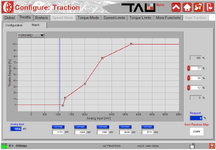
So, here's mine, it's a TOTAL mess and I hate it:
1725575974771.png

I can't seem to get the smooth take off like I want, it's a 'k-chunk' every time and then a bit slow start then, like you said, at a little past ~5-7mph, it goes WAY to fast.

Don't forget, with my set up, I can shift the stock transmission - still with NO CLUTCH. So, much of the time and especially around town, I start in 2nd and then shift when it goes a bit.

Functionally, it works great but I really want a smoother overall curve. I hate it.
 
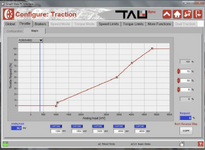
Here is a map from a dingleberry from the DIY EV site that refused to share the rest of his Hunter tweaked profile:

1725576575864.png

I mean it's pretty, I haven't tried to duplicate it yet.

He does NOT have a Jeep so I'm not exactly sure it helps any of us, more is better, I guess.

Can you post yours please.

- Patrick
 
Ignorant question, how is it that you can't make this precisely whatever you want whenever you want as easily as setting an idle adjustment screw? I would have thought something like this would have been the easiest thing ever to play with on these setup? I have a pedal commander thing for our Renegade that I can set the curve however I like in a matter of a minute, tops, via a bluetooth connected app. With these, I assumed that you'd almost have on-demand ability to play with this?

I know zero here, just going off my experience with the DBW dealio on the Renegade that I mentioned.
 
Ignorant question, how is it that you can't make this precisely whatever you want whenever you want as easily as setting an idle adjustment screw? I would have thought something like this would have been the easiest thing ever to play with on these setup? I have a pedal commander thing for our Renegade that I can set the curve however I like in a matter of a minute, tops, via a bluetooth connected app. With these, I assumed that you'd almost have on-demand ability to play with this?

I know zero here, just going off my experience with the DBW dealio on the Renegade that I mentioned.
Trite but true, especially here and with this topic - There are NO SUCH THINGS as ignorant questions on this subject.

The thing you're doing, which is what we do to 'understand' anything new - we like to equate IT to what we know. The old method of using a water hose as a metaphor for how electricity works, is a great example.

Unfortunately, that simplistic explanation of Carb Idle Screw adjustment being similar to a Throttle Map doesn't hold up for this. The Pedal Commander is VERY cool, very smart piece of gear. It comes closers but only if you understand that at the heart of Pedal Commander is nothing more then a smart tap to change the curve, dwell, all timing, active and other wise (like I said, a pretty cool device).

With all electric motors, you have Profiles, usually only 3 of them and maybe modes, only two of those.

Profile is a set of tables that tell the motor how much Regen to apply and under what circumstances. Mode is more of a general 'Eco' vs 'Speed' thing.

The Throttle Curve is a thing that is at the heart of both of those.

BUT, here's the problem, setting the Throttle Map dynamically is not something you can safely change due to a bunch of dependent things as well as it's a tad difficult to 'write' to a motor while it's actually running.

ALL that being said, this motor does NOT make it easy to map or understand all the variables. Nor does it make it easy to just swap in a new or saved 'curve'. This is a clear opportunity for companies like Pedal Commander to step in at some point and provide easier ways to do this (if that's possible).

Everything on an EV is about two fixed variables - CCL and DCL - Charge and Discharge Current Limit - how much juice you can add and how much you can take out from your batteries at any given moment.

Along with those two variables is a good bit of dependent settings like operating temps, SOC (State of Charge), physical capacity of both the motor and battery module packs, etc...

I wish it was more easy and I'm sure it will be but for now, 3 Profiles only. They are exactly like the Pedal Commander's Eco, City, Sport and Sport+.

WE, on the build side, have to design each of those Profiles so you can pick them when you need them. For the driver, changing the Profile is as fast as pushing two buttons.

Building those Profiles is more involved and probably isn't the realm of the average driver.

PLEASE let me know if this helps or at least where your eyes started to glaze over so I can pull back next time...

- Patrick

 
Time to post the number.

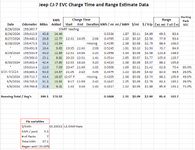
Here's my collected data set for Range and Mi/kWh. To summarize, I'm getting about 2.3 miles per kWh or about $0.09 per mile based on what electricity cost me here in Los Angeles.

1725652567759.png

By comparison, my Chevy Bolt is getting a Lifetime of 3.7 mi/kWh but very often we get about 4.4 mi/kWh (not crazy driving, ideal outside temps, a tail wind, flat as all of Kansas OR started at the top of a hill, etc...).

I'm not gonna' lie, for a Repower Starter Kit, 2.31mi/kWh is a home run.
 
Here is a map from a dingleberry from the DIY EV site that refused to share the rest of his Hunter tweaked profile:

View attachment 114927

I mean it's pretty, I haven't tried to duplicate it yet.

He does NOT have a Jeep so I'm not exactly sure it helps any of us, more is better, I guess.

Can you post yours please.

- Patrick
This Map is worthless. Don't bother replicating it, it's ca-ca.
 
500+ Miles traveled in 16 days!

Range Update:

Image


I try to get in at least 20 - 40 miles each day. Always a combination of surface streets and highway travel. 65 to 75 mph highway is normal and VERY smooth. I charge each time I park back at the garage, you can see the charge times above. Longest single trips are around 45 miles. In total, driving 522 miles cost $46.37!!

I'm averaging a little under a $dime /mile.

I've had 5 'break downs':
  • Drove too fast up a hill, exceeded 500amps, a fault kicked and saved the fuse from blowing ($150 ea.!). Reset BMS and resumed driving (after being towed home, sad...)
  • Failed to secure wiring, ripped the Key Sw. ON wire in the steering shaft - *******! Fixed with pliers and zip ties in driveway.
  • Overheating 1 - super warm night, I charged before I want out in the evening, charging causes heat in the battery modules. When I got about 25 miles from home with no tools, it stopped responding to throttle. Hooked up the laptop, it was above 50C (~120F) in the battery modules. Two things: 1) Once I figured out the problem, I sat and waited till it started to come down and hung out in Pacoima (not your most welcoming hood at 1am), 2) I need to hook up the active cooling for the modules - *******.
  • Overheating 2 - STILL hot has, you know, hot - Inverter was way above 120F, kicked a fault. Changed the layout of the Inverter in the Tech Box to invite more cooling. Works great now.
  • Dipped into my Under 10% battery SOC, limped home. *******...
About breakdowns: Yes, it's DAMN scary when it happens, not safety wise, no, it's just like running out of gas; slow roll to a completely controlled stop with your brakes and steering all working because they use the 12v battery to power their pumps and such, all Jeep lamps worked all the time, blinkers and brakes lights - nothing goes out when you breakdown [insert man doing the least emphatic Jazz hands here].

No, the panic is because your mind jumps to EVERYTHING that could go wrong, fire, short, blown battery, fascism , global thermonuclear war, all running through your head as you effortlessly glad to a stop on the 118 freeway (a CRAZY fast freeway near me, 85mph is the norm, 100++mph is common).

After you pull over and realize you're not dead or on fire, you start running through what it could be and what happened before to cause it.

After the first couple times, it's easy. My steps:
  • Pull over, secure the vehicle.
  • Get out, inspect, back of hand feeling all the battery boxes for obvious high temps (never found one), look at all the things, not much to look at, sniff for burning wires and such.
  • Grab the laptop, check for faults
  • It's always a fault: Read the fault, decipher what it means, double check with other variables on the laptop (all battery module temps, motor temp, inverter temp) to confirm what and where the problem is and fix it, if possible.
Mostly, it means either a slow limp home, under 20 mph (only once did I have to limp back the final 7 miles home) or waiting till the temps go down. The good news is, they go down quickly when not in use. Longest I've ever waited was 45 min, made some lasting friendships at the Pacoima Sip & Fill at 1am, truly, not kidding, Thanksgiving plans have been made....

Enough, conclusion time [the crowd cheers], once you kinda' lose the fear of exploding and you've got a few of these things under your belt, AND have address some of them (active cooling installed and all that jazz), it becomes so much less panicky and more 'ok, what do I need to fix or update or upgrade or make better so this one problem is not going to happen again? '.

Panic subsides, calm prevails, the sound and feeling of the cool evening air rushing by with no motor vibration or sound wins the day and night.

522 MILES in 2 weeks of driving!

Image

(yes, I put my hood back on, helps with airflow and looks less janky)

- Patrick
 
A few comments.

  • Overheating 1 - super warm night, I charged before I want out in the evening, charging causes heat in the battery modules. When I got about 25 miles from home with no tools, it stopped responding to throttle. Hooked up the laptop, it was above 50C (~120F) in the battery modules. Two things: 1) Once I figured out the problem, I sat and waited till it started to come down and hung out in Pacoima (not your most welcoming hood at 1am), 2) I need to hook up the active cooling for the modules - *******.
  • Overheating 2 - STILL hot has, you know, hot - Inverter was way above 120F, kicked a fault. Changed the layout of the Inverter in the Tech Box to invite more cooling. Works great now.
I have cooling running threw my battery boxes and under a heat transfer plate for my controller. I haven't had any issues with overheating. I used a small radiator and a bosch coolant pump that comes on when driving and charging.

Don't forget, with my set up, I can shift the stock transmission - still with NO CLUTCH. So, much of the time and especially around town, I start in 2nd and then shift when it goes a bit.

I shift gears quite a bit, in fact I drive it more like a manual than an auto. I am curious how you shift without getting on the clutch. I also use the clutch to manage the lurch from a dead start. I probably get ~2.5miles per KWH in 3rd gear (if not more).
 
A few comments.

  • Overheating 1 - super warm night, I charged before I want out in the evening, charging causes heat in the battery modules. When I got about 25 miles from home with no tools, it stopped responding to throttle. Hooked up the laptop, it was above 50C (~120F) in the battery modules. Two things: 1) Once I figured out the problem, I sat and waited till it started to come down and hung out in Pacoima (not your most welcoming hood at 1am), 2) I need to hook up the active cooling for the modules - *******.
  • Overheating 2 - STILL hot has, you know, hot - Inverter was way above 120F, kicked a fault. Changed the layout of the Inverter in the Tech Box to invite more cooling. Works great now.
I have cooling running threw my battery boxes and under a heat transfer plate for my controller. I haven't had any issues with overheating. I used a small radiator and a bosch coolant pump that comes on when driving and charging.

Don't forget, with my set up, I can shift the stock transmission - still with NO CLUTCH. So, much of the time and especially around town, I start in 2nd and then shift when it goes a bit.

I shift gears quite a bit, in fact I drive it more like a manual than an auto. I am curious how you shift without getting on the clutch. I also use the clutch to manage the lurch from a dead start. I probably get ~2.5miles per KWH in 3rd gear (if not more).
Oh man, I'm SOOOO glad you chimed in - mostly about your range - we're getting about the same range!! That makes me feel more confidant about my math and overall design - thanks for sharing that.

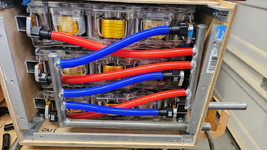
As for cooling; right now, I'm cooling just the Inverter through a Tesla pump (a GREAT and cheap pump!). I've already built the collector manifolds:
1726248773515.png

Next picture in next post due to errors posting....
 
1726248841931.png

Obviously, this is an old picture since the battery box is now all aluminum and this is a plywood prototype.

So, now the goal is to attach all this up on a single loop - Inverter, all battery modules, pump, small radiator from Derale Cooling.

I'll hook all that up this weekend, ore at least some of it. I have to redesign the two cross members that hold up the battery boxes and Tech Box such that I can have a 4" forced air blower pushing grill scooped air directly on the motor to bring down the temp AND move the heat blanket that form around the motor to a viable passage down and away from the motor area.

The OBC (On Board Charger) has it's own fan.
 
So, shifting, not an easy subject to write about but I'll briefly say this: The clutch has three basic functions:
1. Allow the motor to detach from the drive train to allow the change of gears
2. The flywheel is used to balance the intrinsically unbalanced nature of an ICE set up (inertia)
3. Start the vehicle

In an EV, you have zero need to balance the motor, in fact, a flywheel will only serve to slowly destroy the EV's bearings over time. I learned ALL this by starting with the belief you had to keep all that crap if you wanted to retain a manual transmission (remember dear readers, there is no real or practical way to marry an automatic transmission with an EV motor - not one way.) After a LOT of trial and error (so many plywood trees had to die in my quest...), I discovered that you can mimic the 'slowing down the motor' dynamic of putting your foot on the clutch and pressing it in by telling the EV motor how long it needs to take to come to a 'idle' speed (RPM).

Once I figured that out, the rest fell into place.

The key in EV installer terms is Natural - you can define what that means and how it works in your set up - I'm using NetGain Motors Hyper9HV (Dana TM4) so my software is called TAU.

In the past day, I've been able to advance my build to include full regen so now, I'll have to incorporate a button on the Stick to tell the Motor 'slow to X at Y rate so I can shift'. (nerd time: I think I'll use the K1-7 as my interrupt circuit, maybe...)

Did yo see the shifting video, here's a like if you missed it:
.

I'm also a big fan of 3rd gear as my general driving gear BUT, I have a Dana 60 in the back (don't ask, it seemed like a good idea at the time...) with 3.73:1 rings. When we were tuning the Throttle Curve, Hunter at NetGain informed me he thinks I need a taller gear (hope I got that right) and suggested moving to 4.10:1's to give me more off the line, which, if I'm being honest, is timid at the moment.

Hope that helps answer your questions, or at least get you started on asking more questions.

- Patrick
 
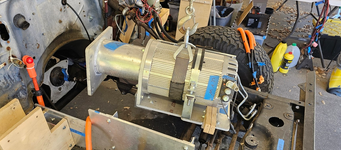
Okay, I can see how this works in theory and know how to program this but does this mean you have a "hard" connection from output shaft of the motor to input shaft of the transmission? Do you have any pictures?
 
Okay, I can see how this works in theory and know how to program this but does this mean you have a "hard" connection from output shaft of the motor to input shaft of the transmission? Do you have any pictures?
I believe this (post#493) is his final coupling design.

Good to see you guys comparing notes. :thumbsup:
 
Okay, I can see how this works in theory and know how to program this but does this mean you have a "hard" connection from output shaft of the motor to input shaft of the transmission? Do you have any pictures?
Yes Sir:
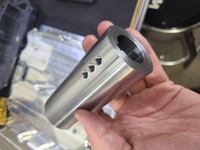
Coupler
1726269716550.png

(I really, really hate this one picture per post thingy you guys have, sucks)
 
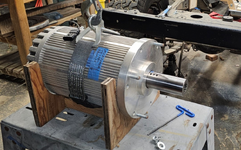
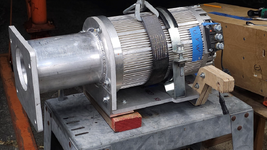
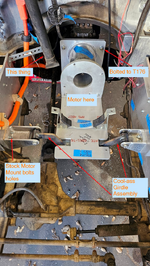
MCA with final MCA Girdle (sans Motor for illustration purposes)
1726270170524.png

Hope that helps give you a better overview.

I just flipped through what I posted above, what a crap load of work, I still can't believe I made all this AND that it works and works well - seriously, color me surprised at the outcome!

- Patrick
 
Back
Top