• Notice for iPhone users: DO NOT use the image size reduction option when uploading photos to the forum. This causes portrait images to post as landscape. We have added a warning to the image insert pop-up as well.

In Tank Fuel Pumps

trust

PITA
City
White Rock
State
NM
Have any of yall put your fuel pumps in the stock gas tank? I'm running the MOPAR EFI on an other wise stock 258 with the 4.0 head and have thought about putting the pump into the tank to help with occasional vapor lock. Ive heard that a 4.0 YJ pump assembly can be snaked into a stock tank but I havent tried it yet.

Experts?
 
That sounds like an interesting idea but I haven't tried it. It looks like the yj 15 gallon sending unit with pump may fit (at least looking the pictures side by side briefly online) Please post if it works!
 
I'm a little more old school. Just like the Howell FI, a pump in the fuel line from the tank makes me happy. The less electrical things in the fuel tank, the better. And if it goes bad, no need to pull the fuel tank. But that's just me. You guys with more savy technical skills can probably pull off the in-tank fuel pump just fine.
 
thanks guys, I get your point Kim, Id hate to have to replace the pump on the side of the road in a snow storm if it were in the tank, its bad enough to replace one inline. But if putting it in the tank keeps the thing running when its 100* outside and it isnt running it might be worth it. I'm toying with running both in parallel with the inline pump being an installed spare but I havent decided if its worth it or even doable

I'll post the results if I go forward with it, I need to drop the tank and pund out some dents in the skid plate anyway so it could be timely
 
Two issues to overcome with a YJ pump assembly;

1) The fuel level sender is built into the YJ pump assembly, and it is not compatible with the gauge in a CJ instrument cluster (the gauge wont read right).

2) The opening in the top of the tank for the YJ pump assembly is much larger than the opening on a CJ tank (you'll have to cut a larger opening)

I've seen a couple of writups where people have taken a generic pump and attached it to the stock CJ sending unit (similar to the setup that Novak sells).

If/when I move my pump into the tank, I plan to cut a small access hole in the bed of the Jeep so I don't need to drop the tank to access the pump/sending unit in the future (won't even need to crawl under the Jeep).


The problem with all of that is the stock fuel tank is not baffled so you have only a few options. If you retrofit a GM fuel pump module into your tank, the module keeps fuel in it at all times and resolves that issue.
 
I can offer some further insight, I just did this on a drivetrain swap.

The stock pick up doesn't reach straight down. It bends part way to bottom of tank and reaches toward center of tank. This puts the pick-up sock end into a little molded in sump in the bottom of the tank (1/2 inch deep maybe, and wedge shaped).
So, cut off the tube and attach a pump, right? Nope. Directly under where the sender goes into tank (referring to diameter of hole) is partially above the up-slope shape of the tank. So a pump that goes straight down into the stock 20 gal tank will not reach the bottom of the tank as it lands partially on up-slope. And I wasn't willing to leave the pump hanging on a piece of hose so it would "flex" to reach the bottom.

So, I bent a piece of tube, and threaded rod as an anchor, to get it upright and on the bottom of the tank. It was tough to fit in the hole, but it can be done.
Then, I was where mysunshine said - no baffles/retainers. So you can never really get below 1/4 tank unless you are on flat ground or you will have pressure problems. And short of cutting an access hole I didn't see a way to make a return reservoir or add baffles inside tank.

Then I found the cool spring-loaded GM unit he is talking about. 20 gal tank has a nice flat spot on top you can cut to get unit in and be flat on bottom of tank and have the stock sender work just fine. It works perfect and was pretty easy.

Sorry for the long post. I didn't do a build thread, so I am sharing info where it seems like it may be helpful.
 
wowsa!! thats a lot of good dope guys, thanks! It sounds like the way to go is to use the GM assembly and not both with the YJ unit at all, do yall have the PN for that assembly or the appropriate application so I can look it up?

Thanks Gents!!
 
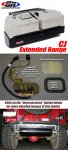
I installed a new 15 gallon tank with the Novak EFI set up on my 5.3 conversion. Since the tank does not have baffles I've decided to go with the Genright 20 gallon tank and use the YJ sending unit and fuel pump module. I'll install an in dash Fuel gauge that matches up to the YJ sending unit. The tank is 1/8 Aluminum and the skid plate is 3/16 steel. Lots of baffles inside.
 

Attachments

  • GST1003new_multi_md.jpg
    GST1003new_multi_md.jpg
    100.9 KB · Views: 145
Thanks Dennis, interesting that stock volume tank is extended range in the aftermarket! lol
 
The early 4cyl YJ has a steel 15 gallon tank with a baffle and an in-tank pump, that bolts in. The gotcha, it fills on the driver's side. I cut a hole and welded up the passenger side. I used a YJ filler neck to get the screw-style gas cap too. Now the wife doesn't need pliers to open the gas cap either. Which means I sometimes get my Jeep back with gas in it. Been sure to use a 4.0L pump as the 4cyl is TBI, not MPI.
 
Trust-
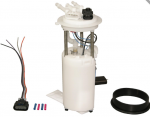
The one I used came out of an early 2000's GMC. Airtex makes a replacement assembly you can buy new if you want. It looks like this:
fuel pump assembly.png

I took the float and arm off and only use this for the pump and return/accumulator. The stock gauge sender still tells how much fuel is in the tank.
 
My YJ-8 project is similar to you-- 1990 YJ, Carbed 258 now running MPFI and occasional vapor lock problems with external fuel pump.

I Swapped in the complete YJ Poly Tank, I had to build/weld in a new cross member out of 3/16 angle, but now I am running a factory fuel system. Also on mine the YJ sending unit did not work with my guages so I meticulously installed my old sending unit on the new pump assembly. It looks factory and works well. This is one option that would solve your issue.

One thing I did that I may not do with an original CJ-8 is I cut a fuel pump access hatch in the bed. that is currently held down with pan head screws but may switch to M4 Rivnuts.
 
Thanks Gents, I have a stock YJ poly tank with that unit in it now, the filler is on the wrong side but perhaps I can work around that. Did that GMC unit go into the stock CJ tank?
 
My new Genright EFI fuel tank should be here today. I all ready have the YJ fuel pump and sending unit for it. I also hope to have my tub back in the evening. I can't wait to start putting it back together again.
 
In general, a fuel pump in the tank has the following advantages - runs cooler, makes less noise, doesn't need to overcome "suction head", looks cleaner installed, pump is protected from rocks and dirt. A good quality pump should last at least 100,000 miles. Couple this with the fact that electronic fuel pumps usually get "sick" before they "die" (you'll notice the engine not making as much power) and you've got a pretty reliable set up. On the other hand, an outboard unit also has advantages - easy to replace, easy to install.

For myself, I started with an outboard unit, but later installed the unit from Novak. I did this for two main reasons 1) the outboard fuel pump was noisy and 2)I was using the original dip tube and when the fuel tank got to about 1/4 full, it started sucking air from the filter sock to dip tube connection. The install of the Novak unit was drag because they'd wired the pump backwards, and I didn't figure that out until after I had mounted the fuel tank. Doh! I will say that Novak tech help responded immediately in assuring me that I hadn't damage the pump by running it backwards and the apology for wiring it backwards made me feel a little better anyway. Case in point, test your fuel pump before re-mounting the gas tank!

I now much prefer the in tank fuel pump. It's quiet and I can get all of the gas out of the tank now.
 
I am running Mopar MPI on a stock 258, factory 20 gallon gas tank, and the Hesco supplied High pressure external fuel pump on my red Scrambler. I have over 25,000 miles on this set up. That 25k includes two cross country trips to Moab, up to Michigan, Missouri, Arkansas, and all over the rest of the Southeastern part of this country, where summer time temperatures exceed 100 with 100% humidity.

1) I have never "starved" the engine/fuel pump for fuel, off road or on road. I can suck my stock tank down to where it takes 19.8 gallons to fill it back up, no problems.

2) My fuel pump does not get "hot". I mounted the fuel pump on the forward face of the cross member that the front of the gas tank mounts to. I have never had a fuel pump "overheat" issue.

3) As for noise, using the Hesco supplied fuel pump, I can not hear the pump over the engine.


I a running factory GM TBI on a stock TBI 350, factory supplied 20 gallon gas tank, and a NAPA low pressure external fuel pump made for a Ford Van/truck with EFI. I only have around 5,000 miles on this set up. That mileage includes a trip to Michigan/wheeling in the dunes for a weak, trips to Sicily Island Louisiana, and trips to Alabama. Same thing as the red Scrambler example, it gets really hot down here!!!!!!

1) I have never "starved" the engine/fuel pump for fuel, off road or on road. I can suck my stock tank down to where it takes 19.8 gallons to fill it back up, no problems.

2) My fuel pump does not get "hot". I mounted the fuel pump on the forward face of the cross member that the front of the gas tank mounts to. I have never had a fuel pump "overheat" issue.

3) As for noise, using Napa supplied fuel pump, I can just hear the fuel pump when the Scrambler is idling. It is not obnoxious, but you can hear it hum. You can not hear it while driving.


The only heat/fuel issues/problem I ever experienced:

1) Red Scrambler, driving north out of Amarillo, TX into New Mexico. I had a tank of crappy gas, drove 2.5 hours at 75mph into a strong head wind, the Scrambler sputtered and died, fuel starved. Plenty of fuel in the tank, fuel pump cool to the touch. My "fuel/heat" issue was from under hood heat - When I poured a bit of gas on the throttle body intake blade, it instantly boiled off!!!!!!!!!! After restarting the Scrambler this way, I continued on driving at 60mph. Re-filled the tank with higher octane/less crappy gas, never had another issue.


2) Tan Scrambler, driving north on I-65 through Alabama in August during the middle of the day, super hot outside, cruising 75-85mph. When the tank would get near 1/2, I would have a bit of hesitation. Immediately after refiling the tank with fresh, cool fuel from the gas stations, no problem. Again, fuel pump cool to the touch. Problem - under hood heat, fuel lines rest directly on the valve cover/front of the engine. Theory - the fuel was being heated inside the fuel lines that rest directly on the engine. The fuel temp is constantly being raised by engine heat, until it starts to boil off inside the stock factory metal fuel lines. These metal fuel lines were as hot as the engine, which runs between 200-210!!! Solution - re-route metal fuel lines off the top of the intake/valve cover, problem solved.

Just my "two cents":shrug:

Also, Red Scrambler "issues" in New Mexico. I even changed the fuel pump on the side of the highway in less then in hour. It did not solve the problem. You can't do that with an in tank pump, unless you have a hole/access cover in the bed floor:shrug:

I like the in tank fuel pumps, too, my old TJ/new LJ had/have them, no problems. On my older Scramblers, I like the external pumps, easier to install, easier to swap out in the field. Just my experience/opinion:shrug:


You are incredibly fortunate, you are the only person I have ever heard of that hasnt had issues with their MOPAR EFI, Maybe its the altitude here, maybe karma, but six friends or friends of friends here have the system, some with 4.0 heads some without, and every one has had fuel supply issues in varying degrees. In my case, mine is mounted just as yours is, runs cool and left me on the side of the road just last month with a 1/4 tank of gas, it was in the 50s outside and engine temp was under the midpoint. I assume it wasnt temperature related, it just couldnt draw the last 1/4 tank. It does that occasionally but not consistently, seems to be just when I forget that feature and dont keep the tank above 1/2...

Im glad yours is working as it should
 
Bumping this as I'm planning on getting a Sniper EFI system and need a fuel pump. I'm thinking about getting the Novak unit so that I can have an in tank system that will work with the OE gauges, which I later want to run the Speedhut units.

Anyone have long term feedback on the Novak pump? Should I just say screw it and run an external pump?
 
Back
Top