• Notice for iPhone users: DO NOT use the image size reduction option when uploading photos to the forum. This causes portrait images to post as landscape. We have added a warning to the image insert pop-up as well.

RispoNY's Scrambler Build Thread - The 'Kit' Scrambler w/ Postal Top (PIC HEAVY)

Copied from Racinrudys web site

* SPOT WELDS: Original Jeep CJs have factory spot welds down the sides of them where they were assembled in the factory and is a sign of original metal. Jeep CJs should NOT be smooth when you look down the side of them. Smooth sided Jeeps may have been patched or have body filler due to rust.


Wow! I had this same conversation with my paint/body guy Saturday. After lots of thinking and talking we decided to smooth those out. On my tub they were a lot deeper than yours - almost looked as it you hit the body with a little hammer. In the end I am building this for me with no plans to sell unless I can't put food on the table. I didn't want those showing. On other parts of the body and grill the welds weren't near as noticeable so we chose to leave them. To each his own.
 
Here is one problem with leaving them in my experience. Once you wet sand the clear coat they are even more apparent because you can't really wet sand the spot welds. So they look weird IMO. I doubt if the factory did much if any wet sanding so they didn't have this problem. I fill them on jeeps I keep. You have pics of the tub prior to paint so no one will question the sheet metal quality.
 
Good to know. You can see the spot welds on just about every place on mine. Decisions, decisions when it comes time for me to paint mine.
 
Last edited:
I smoothed out all the spot welds on my tub, fenders, around the wheel well openings, everywhere. Now that the body is painted and polished I'm glad I did. If in the future you're starving and have to sell the Jeep, and the deal breaker with a prospective buyer is whether or not the welds are present... well.. I'd starve a little longer and look for another buyer.

The reason AMC didn't fill the welds is the same reason the rest of the welds on the Jeep aren't filled and seams have slag and left over filler rod. It was meant as a utilitarian vehicle. An off road tool and adventure machine. A basic all purpose vehicle, not a show car. Since then, and now, people like you and I taking these to the next level with pristine paint and all the latest do-dads. In the end it's your Jeep so make it YOUR Jeep. Have fun!

https://www.cj-8.com/forum/showthread.php?33830-The-beginning-the-end-and-a-fresh-start
 
Last edited:
that paint looks familiar... no primer, has held up fine for yesrs

128_2817-1.jpg

128_2892-1.jpg

129_2936-1.jpg


cb
 
Ah Spot welds - one of my favorite subjects. Spot welds from the factory are different than spot welds 25 + years later. This subject could be a class at a local college - it has to do with chemistry, tension, compression, volumetric expansion, and the speed of light. Have I bored you yet? Or do I sound like a tool? If not, read on.... ;)

Jeep used spot welds at all seams where two surfaces of metal are joined together, typically an "L" and an "|" as represented on the keyboard. Think "L" as your bed panel and "|" as your body side panel. All body makers used this process, and its not new, and as excellently stated above, jeep didnt smooth them out, grind them, fill them, etc. So...A jeep body that has not had any exposure to the elements or father time... lets pretend we can go back in time to say 1983, and be standing on a showroom floor right now with 10 CJs parked in it, and 50 more outside. If you walk around, youlll see spot welds of various impressions and depressions in the paint, one here and there, with a differnet level of penetration of the weld, be it a higher voltage, application method or different spacing. Youll notice these but not standing out like crazy, unless it was a really bad day at the plant and a setting was wrong and a low voltage will create a high mark above the paint, or a high voltage will burn through more creating a little deeper spot weld. But ulitmately, the process for the most part doesnt make these very evident marks, and a "proper" spot weld you'll still see each and every one of them, but without effecting the "|" too much. And then the most important thing to remember from this visualization is that the panel is still straight, minus these tiny "zits" Looking down the panel - its still a flat piece of metal, now structurally attached to the "L" part. This is the best way I can describe a virgin jeep body and spot welds as new.

As time goes on however, even the most "rust free" jeeps unless absolutly a survivor that has not had the process I am about to describe start, will start to have some movement / pulling / pushing goin on within those spot welds. And chances are, this process is going on in a few places, but not all. The very first thing that happens is the metal in the joint starts to rust. the surface is bare metal within these joints and VERY prone to rust, and is protected intially by seam sealer applied at this seam. As time wears on, and in a very different rate based on climate/moisture exposure/ quality of seam sealer application etc the metal will start to rust within the joint. When this happens, the rust expands and has no where to go so it begins to push the metal outward. However, wherever there is a spot weld, the spot weld holds on and areas that are between the spot weld begin to bulge more. As this happens over time, the early stages make the body look like normal spot welds to most, however the tell tale sign is the wavyness in the metal. Going back to the "|" panel discussion, remember that panel is a flat body side panel when assembled new. with no rusting going on, it would still be flat. But as the expansion occurs, it creates a very noticeable distortion down the body side, relative to the amount of rust going on. and then as more rust happens, some welds let go, and then you have a situtation far beyond what we are talking here. Early stages of this are then yes more noticeable to the eye, you cant paint them and then buff them, and youve got a decision on your hands. I see that small section in front of the wheel well on Rispony's tub as one of those areas. it happens to be one of the most typical areas on the scrambler also, which after all is a cargo bed and as intended exposed the elements more than other areas of the jeep.

My opinion on some of the situations above is to ultimately do what you want to do formost, and fully agree that any spot weld already seperating you are just not gonna like it when its painted and done and looking back at it. Another contribution to this is todays paint processes, which rely heavy on clear coat to take out any imperfections later. Your end result is going to be much glossier than jeeps back in the day, and yeah if you catch those welds, even virgin ones, at the right light angle your gonna wanna spit up your breakfast. A Jeep like surfjeeps, fully agree take em all out, the end result is spectacular, and wow what a build. Rispony, Id smooth out the ones that have made wavyness to the metal over time, and leave the others. :twocents:
 
Um that was more like 25 cents .. great read. .

Sent from my SPH-L900
 
Great information Jersey. Now what to do? :banghead: It's up to each person doing a restore and making and living with the decision they make. For me, I still don't know what I'm gonna do, but I still have some time before I get to that decision point...
 
I debated this on mine as well. Mine are smoothed out. Father-in-law won the argument because he wasn't going to let anything leave his hot rod shop that wasn't nice and smooth. Plus I have all the pictures of the rust free tub before any bodywork/paint was done so I can show any potential buyer if I ever sell.
 
I debated this on mine as well. Mine are smoothed out. Father-in-law won the argument because he wasn't going to let anything leave his hot rod shop that wasn't nice and smooth. Plus I have all the pictures of the rust free tub before any bodywork/paint was done so I can show any potential buyer if I ever sell.

Yep no one has ever looked down the side of jeep paint job and said "man that is too straight I wish I saw some waves!".
 
Jersey, that was exactly the info I was looking for. I googled everything and couldn't find 1/16 of the information you just taught me! Thank you immensely. Note, the pictures can be very misleading. The three very noitcable spot welds that can be seen in the last picture posted of the tub, the ones by the driver side door...all the spot welds look like that. I just got a bad angle in the other photo. The reason they look wet in the photo is because we sprayed some alcohol on them to be able to see them better in the light. They all are that 'bold' around the whole tub and are almost identical to door dings in depth/feel.

Anyways, I went back to speak with the painter and we came up with a plan. He told me that we should put a light coat of bondo on it just to take out that waviness Jersey mentioned when the spot welds begin to bulge. Not to fill them in necessarily, but to straighten the panel out a bit. On top of that they're gunna spray a coat of epoxy primer, and then rust defender. Then color and clear. He absolutely hates using bondo, but said that a super light coat would ensure perfect straightness. However, he told me something interesting. He said that no matter how much bondo and body work you do to those panels, eventually the spots reappear, it's just a matter of time. Since the ride is rough in a jeep and the body does a lot of twisting and flexing, eventually those spot welds will begin to show through the paint. Basically, once it's out of paint, it'll be smooth as silk, but with enough driving, they'll come back. I actually like the utilitarian authentic 4x4 look so I was leaning towards keeping them. This way, I get to keep them (eventually) and the body panels get straightened out a bit too.

Having never worked on a car until about last year when I got my first scrambler, I thought painting a car was as simple as choosing your color and being able to afford it. Now, I find myself going in there every 3 days to tackle a new 'issue' and frankly I love it. Learning so much, and I'm glad to have you guys along for the ride!
 
In the meantime, I was doing some heavy googling and found a sandblaster out of Sayville, NY out in long island who is super super reasonable to do all my body pieces and frame and axles. Michael J. Gallagher Blasting. The rates are unreal compared to what I'm used to, and the work they do is fantastic. They company has been in the family for three generations and they focus on major work, for example, they are blasting and epoxying (oh yeah, and they paint too!) all the steel for the new world trade center. I got a tour of the facility and it's insane. They're 'blasting cabinet' is a 1000-1500 sq.ft. warehouse. It's so big that he told me they often have truckers come to have their entire rig blasted. There's proof on his website of dumptrucks and cement mixers in there to boot! So yeah, they love taking in little side jobs and are the friendliest people around. For my two fenders, grill, hood, tailgate, roll bar, half doors, and hard doors, he asked $300. For the axles, he does them for $40 each. And for the entire POR-15'd frame, $220. Oh yeah, and that includes epoxy priming them in the same industrial primer he's using on the world trade center steel!! I dropped off all the parts today at around 4 and he told me to come back Monday-Tuesday to pick everything up

P.S. I plan to post all the prices I pay for the services I'm getting done so people in future builds understand exactly what everything would cost. (I'll let you all know when I get the final quote from the painter) If I missed something, let me know.
 
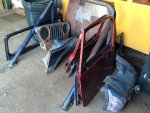
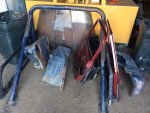
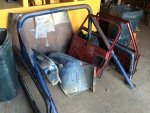
Here are some pictures of the body parts, next week when I go to pick them up, I'm dropping off the frame and axles. (Forgot to mention, I have two windshield frames in there, I'm replacing the one on my black scrambler because it's warped, i.e. when folded flat, one side sits about an inch and a half higher. May not seem like much, but the doors fit like garbage and the top is all pulled wrong)

photo 3.JPGphoto 1.JPGphoto 2.JPG
 
Thanks for the kind words all and glad I could help. I'd like to follow this post up with some pics of what I am talking about through a new thread elsewhere and not clog up your very anticipated build. :thumbsup:

I'll give a little more info though related to what you're about to decide and that is your body man is on to something when he says that but whats really happening, at least in the CJ body world, is that the rust that's already starting to make those bulge really can't be stopped unless its completely sealed from any moisture and still that's near impossible to do unless u drive in a bubble so the myth that they continue to pop, well yeah they continue to pop because they're still rusting where u cant even see. Yes, there's a bit of flex going on which also contributes to it but in my experience what u see happening is rust doing its thing in places you can't even see. I've seen and I own jeeps with well over 100k miles with no popping including an 86 from New Mexico with 165k hard miles, 4" lift, 33s, etc but from the best climate hot and dry. Except for a few offroad run ins with trees there isn't a single dent, pop, pulled spot weld or anything it looks the same as it did from new.

My best advice to you is as you say fill those pronounced ones in. And nothing wrong with a skim coat of bondo it's what goes over the bondo that's most important. Proper sealing with steps you say will ensure that area is fine. But what you can do to help prevent them coming back or waviness getting worse elsewhere is to re seam seal the exposed parts of each joint top and bottom. Keep as much elements out of there as you can.
 
My best advice to you is as you say fill those pronounced ones in. And nothing wrong with a skim coat of bondo it's what goes over the bondo that's most important. Proper sealing with steps you say will ensure that area is fine. But what you can do to help prevent them coming back or waviness getting worse elsewhere is to re seam seal the exposed parts of each joint top and bottom. Keep as much elements out of there as you can.

I too am thankful for the info jersey. Good stuff!
I agree with your conclusion strongly "fill those pronounced ones in" you will not regret that decision.

On cjs sometimes you will notice a wave in the side body panel under the door. This usually happens after the rig has been used off-road numerous times with frame and body flex/articulation. This does not mean neccisarily it has been abused. I have seen on a few cjs over the years where owners have tried to cover up this wave/ripple with bondo that has started to crack and break off. I'm a rookie when it comes to body work but I imagine the cracking was from not putting it on in layers...
 
Thanks z2w...the Bondo issue cracking in that area is likely because that area just keeps flexing and there is no way the bondo can hold on, regardless of thin layers or not, it would start to come loose layer by layer..Bondo has flexible properties for sure, but it is not intended for an area like that. When the body develops those waves under the doors, normally up under the hinges and near the jeep "stamp" its from the body flexing past its "bend" point so to speak and it cant return to straight. These same dents/waves can also be the sign of a front end collision or some sort of accident.
 
The seam sealer is good stuff, but one thing to watch out for: the paint will crack on the seam sealer, depending on how you use your Jeep:twocents:

When I had the body work done on my red Scrambler, I was concerned about moisturing getting back inside all of the little hidden joints/seams in the body. I told the body guys to be sure that they adequately sealed all of these areas. They did, and so far the seam sealer has held up great.

BUT, I use my red Scrambler off road. It is wheeled pretty hard. As a result, my body/frame is flexed a bunch, way more then the typical restored car/truck/Jeep. One thing I have noticed - The seam sealer is still fine, it has not tore or cracked. But, since my body gets flexed, and the seam sealer has remained flexible, the paint has split on top of some of the sealer. The sealer has not tore, but the paint can not flex as much as the sealer:shrug:

Like what was mentioned earlier, these things were designed/built and originally finished to a level that is/was adequate for a "utilitarian" vehicle. The thin sheet metal, and the lack of structural member to really hold the tub ridged, are not condusive for a perfect, show stopping appearance, IF you are going to use the Jeep for its intended purpose. If it is just going to be a DD and see very light trail usage, it will be fine. But if you plan on really wheeling it, I would not go overboard with making the vehicle flawless:twocents:

The people that did the body work on my red Scrambler restore older cars and trucks. They were not "Jeep experts", so some things were foreign to them. The seam sealer for instance. Most people want the sealer almost invisible, they want a smooth/perfect appearance. When I told them to apply it as thick as necessary to really seal the gaps, to maximize the sealing ability, it was a bit foreign to them. I also purposely left some small dents/dings/waves in the body tub. I knew it would be a waste to try to make this tub "perfect", since I was going to wheel the Jeep. Even with these minor "flaws", the Scrambler looks/looked really great, almost like a "natural" beauty as opposed to a "Honey Boo-Boo too much make up" appearance. They still think I am crazy for taking the Scrambler off road. When I first put the Scrambler back together, it was near "flawless". Over the years, and the 17,000 miles of "not easy driving/but not purposely abusive" usage the vehicle has seen, I have definitely "depreciated my Scrambler through fun":D It happens, and that is why I built this Scrambler:twocents:

I guess what I am trying to say, don't go overboard with the finish/paint work IF you are going to use the Jeep hard:twocents: Do a good job, make it look good, but don't try for perfection. It is a Jeep after all:twocents::wave:

Besides the small splits in some of the paint on top of some of the seams, I have not really had any other issues since I sand blasted/welded in new floors/and had the Scrambler "re-finished". My Scrambler had some rust, and had extensive metal repair work done to it. It is always in the back of my mind that the rust could reappear. So far, it has not. But, I do thoroughly clean/dry the Scrambler after I take it wheeling, and it stays indoors when not in use, which is probably the best way to prolong the life of the vehicle.

My Scrambler had 150,000+ miles on the tub when I bought it. So, it already had some miles. I continue to put miles on it, and use it. Eventually, I am pretty sure, my tub/body will start to have issues again. It is just the nature of the beast. Thin sheet metal can only be flexed so many times before it start to weaken, then eventually start to tear. The in cab cage I installed really helps the tub in the rigidity department. So, I have taken some steps to reduce metal fatigue. My first CJ had close to 300,000 miles on it when it was stolen. With that many miles, and the age of the metal, it surprisingly did not have much rust. BUT, the body tub was beginning to fail. All the spot welds were tearing, all the joints were failing, and the floor boards/sides of the Jeep were actually starting to tear apart. Will the same thing happen to my red Scrambler? Maybe so, especially if I continue to drive it and wheel it, that is just a fact of Jeeping:twocents:

I say all this, not to thread jack or scare people, but to just share my experiences. Other will have different experiences. I guess to sum it up, make it look great, but I would not strive for perfection. The first scratch/dent hurts bad enough:cheers:
 
Wow, Jersey and Sparkrjs, you guys are the best. Thanks once again. With all the :twocents: in this thread, I can go and buy myself an ice cream! After reading and rereading all of the posts, I decided that seam sealing is really what I need to focus on. I don't mind the spot welds at all, I quite like them actually. However, it's whats causing them that I'm now going to focus on. I re-contacted my painter and told him that the light coat of bondo would be fine to hide some of the spots, but that I'm not too concerned with 100% straightness. I told him I'd like it to be straight but I won't be arriving with a laser to check once it's done. He assured me regardless that the light coat would still cover them all up for now. I did mention that seam sealer should be used heavily around the inner panels of the tub any and everywhere that could be a potential issue. I am having the inside of the tub painted as well and I told him that I don't want it to chip and flake off on the spots where there is seam sealer, but I am more concerned with protecting against rust that having an award winning paint job. All this will be done no problem.

One thing he asked me was if I wanted to use seam sealer around the front area of the tub, where the cowl meets the body. I've seen many CJ's filled with whatever in that external seam that it almost looks like a crease in the metal rather than a body line. I told him to do a light coat just in the crack there to ensure it's protected, but make sure that it will not be entirely filled up and still as sharp as before. I'm extremely confident in the shop and have seen some of the work they've done so I know they're more than capable of working on some old jeep :rotfl:

.JPG

After going through the parts to drop off to the sandblaster, i realized I was short a dash. The laredo dash that the PO provided me with had other additional guages cut out and the speaker holes and radio cutout enlarged so it's unsalvageable. I'm in the market for one, so unless I can find an original in the next coming weekend/early next week, I'm going to order a replacement. Any advice on brands? I know omix makes terrible replacement fenders and what not, but are they're dash's better quality? I found a brand called 'Logan's Metal Products' that's features on Morris 4x4 that has stainless dash panels in a ton of different configurations. The one I'm going for has the Laredo tach and clock cutouts and speaker cutouts, but no radio cutout. This is exactly what I had in mind. Has anyone used them that can provide me some input on their quality. Here's the product in question:

http://www.jeep4x4center.com/dash-stainless-steel-lmp-768609.html
 
Back
Top