• Notice for iPhone users: DO NOT use the image size reduction option when uploading photos to the forum. This causes portrait images to post as landscape. We have added a warning to the image insert pop-up as well.

Belizeit's 1984 CJ-7 Engine Swap/Upgrade

Some easy work, some slightly PIA work.

Received and installed the "intake manifold heater/choke" relay":

20221020_172253.jpg

20221020_172259.jpg

20221020_172905.jpg

I also installed, about 95% complete with, the rear fuel pump module harness. Two wires run from under the hood to the fuel tank:

1) the fuel pump power wire from the Holley Sniper wiring harness relay
2) another "has to be battery negative post" ground wire from the fuel pump harness up to the battery

I ran these two wires together, down the firewall, and then along the OEM fuel supply line, down the passenger side frame rail, across the forward fuel tank crossmember, over to the driver side of the fuel tank where the fuel pump module harness hangs out:

20221020_184604.jpg

20221020_184625.jpg

20221020_184642.jpg

I just need to finish some wire loom on the end to be 100% finished with this circuit. I hope to finish up my remaining wiring work this weekend (oil pressure gauge, secondary temperature gauge, aftermarket tachometer). After that, build an exhaust system, clean/install an OEM air cleaner, transfer case shifter, and some other odds and ends.

IF everything goes right, MAYBE try to fire this thing up next weekend :fingerscrossed:

That's it for now :wave:
 
Started out good. Finished up the fuel pump module wiring:

20221021_163951.jpg

Removed the radio to pull out the OEM oil pressure gauge:

20221021_165426.jpg

No problems there. This fell out from behind the dash when I pulled the radio, part of the radio install kit? Not concerned with it, but interesting.

20221021_165443.jpg

Cut the wires, put new ends on, installed the new VDO oil pressure gauge, reinstalled the radio. Turned the key ON, gauge pegs out. Pull it all back apart, thinking maybe I grounded the sending unit wire:

20221021_201310.jpg

Nope. Checked all the wiring, all good. Hook up another gauge, works fine. The new oil pressure gauge is broken. With power hooked up, as soon as you hook up the ground wire, it pegs, irregardless of the sending unit wire.

Tired, frustrated, aggravated, so called it a night. I will have to go one town over in the morning to swap the broken gauge for another new, hopefully functional gauge. Will install the new gauge and then switch gears to exhaust work.
 
The new gauge behaved the same as the old gauge: hook up power abd ground without the sender, needle pegs. Figured it wasn't a defective gauge, so returned home with original gauge.

Left the sender wire disconnected at both ends, put 12 volts on it:

20221022_092112.jpg

No voltage at the gauge end of the wire. Pulled the wire out the loom, found a break in the OEM sender wire:

20221022_093012.jpg

Repaired the wire, installed and hooked up the gauge, it is working correctly now. Radio still works, too. Glad to be over that hump.

20221022_100453.jpg

Test fit the head pipe that the local exhaust shop bent up for me, fits like a glove:

20221022_102905.jpg

20221022_102927.jpg

I only had to cut a single piece of 2" OD pipe about 28" long to finish up the exhaust. Mocked up:

20221022_131043.jpg

Hard to take pictures, but all installed. I left the clamps and hangers loose for now. I should get the tailpipe frame hanger early next week. Once I install the tail pipe hanger I can finalize the installation. Overall, I am really happy with it, and it fell into place.

20221022_142820.jpg

Once I mount up the tailpipe I will finalize any adjustments needed at this hanger:

20221022_142829.jpg

Tailpipe routing:

20221022_142836.jpg

20221022_142859_HDR.jpg

Won't cry about the oil pressure gauge issues, especially since the exhaust fell into place!!
 
Wiring, exhaust, and now more wiring. This should be the end of my under hood wiring!!!

Used a black wire for the VDO temperature gauge sending unit wire. It will blend in better being black.

20221022_155137.jpg

The Sniper comes with a 10 pin output harness. This can be used for AC, electric fans, all sorts of stuff. Since I had to tie the MSD 6AL tachometer output wire to the main Holley Sniper wiring harness, I need to use the tach output wire on this 10 pin harness to drive the aftermarket in dash tachometer This is the only wire that I need, so I de-pinned the other wires. A small safety pin works perfect for this, thanks YouTube!!!

20221022_150107.jpg

I used black RTV to seal the unused wire ports. This can easily be removed in the future and additional output wires can be reinserted into the connector if needed/desired.

20221022_151119.jpg

Routing the tachometer sending unit wire, temperature gauge sending unit wire, and the Holley Sniper LCD display screen wire along the firewall:

20221022_155131.jpg

I have a few damaged feed back wiring harness looms, so I cut one in half so I could remove the OEM firewall plug. I was going to make a steel plate, but sometimes simpler is better, and easier!!! I ran the LCD screen harness and the two sending unit wires through this plug:

20221022_204350.jpg

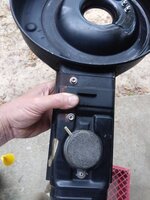
Cleaned up a non-power brake air cleaner assembly that I had in the spare parts bin:

20221022_170301.jpg

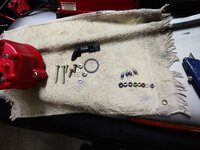
Removed all the unneeded doo-hickeys, plugged up the holes. I mainly used rubber plugs, but for the four smaller holes I used #10 bolts with nylock nuts. Don't want something to come loose and get sucked into the engine!!! This really only pertains to two holes that are inboard of the air filter. I plugged the old pulse air tubes on the outside, and the inside. One of the tubes was a little rusty on the inside, so I plugged up the inner ports to keep the engine from sucking in old crud.

20221022_173807.jpg

20221022_173811.jpg

20221022_173815.jpg

And installed:

20221022_174912.jpg

Still need to adjust and install the distributor, build the spark plug wires, install the secondary coolant temperature gauge, install the tachometer, install the twin sticks and floor board cover and boot(s), finalize the exhaust, PCV fresh air hose and elbow......

I can almost see the light at the end of the tunnel!!!!


That's it for now :woot:
 
Finished up the VDO temperature and VDO tachometer wiring today.

Bought these fuse panel taps off eBay. The plastic parts are used, the metal terminals are new.

20221023_093546.jpg

Used an RC car tool to crimp the metal end on to the wire. Been awhile, little rusty, but it is secure.

20221023_094214.jpg

Assembled:

20221023_094248.jpg

I plugged it into the cruise control slot. I am using this one terminal to power both gauges. You can still see the OEM fuse panel tap plugged into the radio slot.

20221023_135541.jpg

And finally finished with all the wiring!!!!!!

20221023_135551.jpg

Had to spend the rest of the day raking up leaves and pine straw before the rain comes.


That's it for now :wave:
 
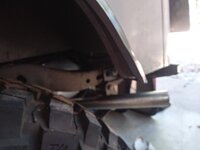
Andy mailed me the frame mounted exhaust hanger bracket I needed. I also needed the little bent piece of metal that connects the tail pipe to the rubber mount. It had some previous exhaust shop modifications LOL:

20221024_172148.jpg

20221024_172153.jpg

A few minutes with the angle grinder, two usable pieces:

20221024_180819.jpg

All mounted up:

20221024_185532.jpg

One little "RedneckRay modification" I had to make, and I have seen this before with the 15 gallon tanks:

20221024_185549.jpg

With a small pair of pliers, I gently "dog eared" one of the gas tank's pinch seam's corner down to gain some clearance. Picture makes it look closer then it is, probably 1/2" clearance. Easy to do, no worries about leaks or damage to the seam. I have seen a few OEM 15 gallon tanks with this bend.

Anyway, exhaust installed and all buttoned up :woot:
 
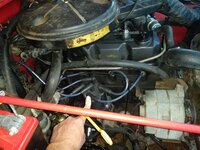
Messed around with the MSD distributor last night.

As far as I can tell, their is not a dedicated #1 position for this distributor/distributor cap. So, I decided to make it mimic OEM installs, with the #1 plug wire being at approximately the 6 o'clock position when viewing the distributor from the passenger side. This will allow plenty of clearance for the vacuum advance canister when fine tuning timing adjustments.

My red Scrambler with a 4.0 and Mopar MPI:

20221025_170907.jpg

1986 CJ-7 with a 258:

20221025_171022.jpg

Even the little AMC 2.5 four cylinder in the 1985 CJ-7 in my yard:

20221025_171201.jpg

Hard to see due to the AC lines, my green Scrambler with a 258 and Mopar MPI:

20221025_171335.jpg

The factory timing curves from the 1982 FSM:

20221025_171802.jpg

The MSD distributor mechanical advance curve possibilities, depending on advance stop bushing and springs:

20221025_171831.jpg

The MSD advance stop bushing chart:

20221025_171935.jpg

The MSD vacuum advance information:

20221025_172150.jpg

Ended up using chart F springs with the purple bushing. I might be too conservative with the purple bushing, I can easily swap it out later.

20221025_172254.jpg

That will be giving me 19 degrees mechanical advance, plus 8 degrees initial timing, plus 12 degree vacuum advance, for 39 degrees TOTAL advance at 2000 RPM with full manifold vacuum (light cruising). This should be OK. On my Mopar MPI equipped 4.0 AND 258, if you drive around with the scan tool plugged in, cruising RPM, it is not uncommon to see up to 38-40 degrees total advance. I used the lightest MSD advance springs to bring the advance on as fast as possible, just like the OEM curve.
 
What comes inside the MSD Pro-Billet Distributor box:

20221025_172308.jpg

A few warnings about cam gears/initial lubricant:

20221025_172315.jpg


20221025_172338.jpg

Information about how the distributor is set up out of the box:

20221025_172353.jpg

The nut that secures the mechanical advance stop bushing. The blue bushing that comes installed from MSD:

20221025_172813.jpg

The included stop bushing and advance springs:

20221025_173216.jpg

I went with the purple bushing:

20221025_173231.jpg

The distributor came from MSD with the two stiffest springs installed:

20221025_173447.jpg

I swapped in the two lightest springs.

20221025_173919.jpg

The two stiffest springs are silver. The medium springs are blue. The two lightest springs are silver, but much finer then the heavy springs.

I left the MSD installed distributor cap "spring loaded J-hook screws" installed. They can be cut off and regular screws used to hold the cap on. IF you do this after you install the plug wires, your plugs will be off one full count.

20221025_174710.jpg

Since I have to build my own spark plug wires i am going to allow for a little bit of slack to compensate for a potential future change to the hold down style.
 
  • Like
Reactions: SKT
The distributor drops in like an OEM distributor, BUT with a few caveats:

1) this distributor is taller then OEM, the base plate sits much higher off the block then OEM or 4.0 OEM
2) the body that encloses the driven shaft is a close fit to the bore in the block
3) the OEM "long tube" engine oil dip stick tube can cause issues

To install the distributor, I had to remove the cap AND the rotor:

20221025_183117.jpg

Took a few attempts turning the oil pump slot/positioning the rotor correctly before I got it to drop in where I wanted #1 to be. In the picture above, the black mark on the base is where I want #1, rotor pointing at #1, engine a TDC. The MSD rotor will only go on one way, so you can't easily get it 180 out. Another note: I had just enough wire from the distributor to connect to the fender mounted MSD 6A ICM. Keep this in mind when picking a location for the MSD box. They do make an extension harness, if needed. I got lucky..............................

Using 90 degree wire ends on the cap, they will clear the dipstick tube support bracket. Close, but it will clear. I "tweaked" it just a hair.


20221025_183752.jpg

20221025_183801.jpg

The #4 spark plug is almost directly behind the dip stick tube support bracket, BUT the MSD plug wires I have use a long straight end on the spark plug end, so no issues there. Everything should work with the "long style" dip stick tube, but in hind sight, the "short straight tube" style dip stick tube assembly would be better for this application. Especially if you want to be fiddling with advance springs and bushings quite frequently. To access the inside of the distributor with it installed all plug wires will have to off first, then the cap, and then the rotor. Not terrible, but the "short tube" dipstick would allow you to leave the plug wires attached to the cap and set the whole cap to the side for tweaking.

I started building the MSD 8.5mm plug wires. Andy purchased a set for a V8, and they are ridiculously long for a 258 application LOL:


20221025_220645.jpg

I would guess that each wire is about 4' long. On a 258, the longest wire might end up being 18". Well, easy enough to shorten, would be a PIA to lengthen. After having a Chevy 350 with ram horn exhaust manifolds that required the plug wires to come up from the bottom of the engine, I do understand why MSD supplies such long wire lengths!!!!!!

Not going to do a step by step on assembling plug wires, but I did build and install a few last night:

20221025_220640.jpg

The ability to make them the exact length you want is nice. But, for me personally, especially on a 258, pre-terminated wires sets are the way to go. Buy, install, done :twocents:

Getting close :fingerscrossed:
 
Finished building and installing the spark plug/coil wire(s). The dipstick tube bracket kind of interfered in my ability to route the wires as neatly as I wanted to, but pretty good:

20221026_182303.jpg

I "think" I figured out how/where I am going to mount the fuel filter/under hood fuel supply line. Random thoughts and notes:

1) this is a factory AMC 2.5 liter four cylinder CJ-7, frame mounted fuel supply line stops roughly at firewall, slight upward bend
2) new fuel tank/in tank pump, regulator inside tank, only need supply line from tank
3) original frame mounted hard line appears to be in great shape

On my fuel injected Scramblers I ran new frame mounted hard fuel lines. I cut these lines over the fuel tank cross member and mounted the post fuel pump filter (and external fuel pump) here. On this CJ-7 I am going to re-use the OEM fuel line. If this was a new hard line I would mount the filter in the rear, on the side of the gas tank, where the fuel tank rubber line ties into the OEM fuel supply line. Since I am reusing this OEM hard line, just to be safe, I am going to mount the post pump filter at the end of the hard line, under the hood, down low off the engine block/bell housing (over the starter). This will catch any potential OEM hard fuel line debris BEFORE it gets to the Sniper Throttle body/injectors.

There are quite a few modern fuel injected vehicles that mount fuel filters under the hood. I am not concerned about any safety issues. It will be mounted low, on the passenger side (away from the exhaust). If you think about, all the 258's came from the factory with the fuel filter over the intake/exhaust, with rubber lines. Now, that is low pressure versus high pressure fuel injection, but still.

As for the fuel filter, Holley supplies this:

20221025_221023.jpg

This filter has 3/8" in/out nipples, I am running all 5/16" line, so not ideal. I could "adapt" from 3/8" to 5/16" but this would be more connectors and splices, so not ideal.

One other note about this filter - On NAPA's website this filter is for 1982 and 1984 Corvettes. These vehicles are low pressure TBI systems. From NAPA's web site, the fuel pump for this year Corvette only puts out 29 psi, 28 gallons per hour (the throttle body mounted pressure regulator reduces this to 13 psi). The Sniper system runs at like 59 psi. I am "assuming" that this Wix filter has a fairly high safety factor as far as burst strength goes? This filter, in an OEM application, only ever saw 29 psi. Holley is running twice that much pressure through it.

On my Red Scrambler, which has Mopar MPI, I have been running a WIX/NAPA Gold 3023 for 10+ years/65,000+ miles. This filter is similar to the above, but three caveats:

1) it has 5/16" inlets and outlets, with nice bubble flairs on the ends (easy to slip/secure rubber fuel line to)
2) the Mopar fuel pump is 90psi, regulated at the fuel rail (so, this filter sees high pressure)
3) this filter fits OEM 90's to early 2000's Nissan/Infiniti fuel injected vehicles. For example, off NAPA's website, this filter fits a 1994 Infiniti Q45. This vehicles fuel pump puts out 100psi. Now, I am pretty sure this filter is before the pressure regulator, so it is definitely rated for high pressure.

I can't tell you what to do here, use common sense. I am confident the NAPA 3023 filter will be more then adequate in this application. I use this filter on my red Scrambler, whose pump runs at a much higher pressure, through this filter, for over 10 years/65,000+ miles with no issues.

Both filters are rated at 13 micron.

I will post up some more pictures/information once I mount the fuel filter, route the line, and tie it into the Holley Sniper throttle body.

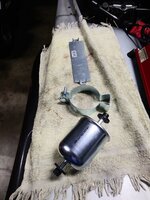
Quick picture of the NAPA 3023, and some $5.00 parts to make a filter mounting bracket:

20221026_205135.jpg


That's it for now :wave:
 
Mounted up the fuel filter:

20221027_183603.jpg

I use this fuel line on all my Jeeps, and Jeeps I work on:

20221027_183732.jpg

20221027_183743_HDR.jpg

The Holley Sniper fuel inlet points directly at the valve cover, which kind of sucks:

20221027_184640.jpg

I bought this fitting to attach the rubber fuel line to the throttle body, worked out swell:

20221027_184651_HDR.jpg

I routed the fuel supply line up and over the valve cover to the throttle body:

20221027_185519.jpg

20221027_185523.jpg

20221027_185531.jpg

All kind of different ways to do this. This was the cleanest, simplest, most serviceable method I could think of. Sure, I could mount a metal line on the fire wall, but then I have more fittings/joints/potential leak points. I ran the hose on top pf the PCV line to keep it directly off the valve cover. Engine heat should not affect this line, I use the same stuff on my red/green Scrambler(s) with MPI, fuel line directly over/by the intake/exhaust manifolds and have not had any issues. And, if you are concerned about it, you can easily swap the line out every couple of years. I changed all of this same line off of red Scrambler awhile back. It was 10 years/55,000+ miles on it, no issues, no degradation, just piece of mind :twocents:
 
And now the return side:

20221027_190209.jpg

This Jeep has the Holley in tank pump, with fuel regulator, so no need for a return line. I bought stuff for two scenarios:

20221027_190215.jpg

Andy already bought the fuel pressure gauge, so I will install it. I do not consider this a permanent device. I will leave it installed for initial start up and diagnostics. I will then remove it. It can then be easily reinstalled in the future to check fuel pressure, if needed. Just a personal thing, but I do not like the idea of this thing being permanently installed, especially over the exhaust.

Close up of the parts I bought, the male plug will be installed directly into the throttle body when I remove the fuel pressure apparatus:

20221027_190224_HDR.jpg

20221027_190228.jpg

20221027_190234_HDR.jpg

And installed:

20221027_191022.jpg

99% complete under the hood, just need to install a rubber line from the air cleaner to the rear valve cover fitting:

20221027_192207_HDR.jpg
 
I also am 80% complete with installing the Dana 300 twin stick conversion kit. Andy purchased a kit from this company, really nice IMO:

20221027_192532.jpg

20221027_192542.jpg

The only issue I had: I had to remove the transmission mount, lower the transmission, to install the big 5/8" bolt. The other issue, on the stick closest to the transmission, the supplied washers that go on either side were a tiny hair too thick, and I could not install the nut. I could have filed down the Dana 300 shifter part, but I found two slightly thinner 9/16" washers in my parts stash, installed them, no problems. When I say a hair too thick, like maybe 10-15 thousandths:

20221027_203107.jpg

And the best news, looks like the sticks come through the floor pan in the OEM location:

20221027_204345.jpg

I ordered, and am waiting on, a combination T176-Dana 300 twins stick shifter boot from Stronghold. This will really finish this off nicely.

A few more minor things to finish up tonight, but it should be ready for a start up attempt tomorrow, depending on the weather/Andy.

That's it for now :woot:
 
Finished installing the Dana 309 twin stick, installed the shifter knobs and floor pan. I had to contact @bigwalton to make sure I put the correct knob on the correct shifter LOL:

20221028_180156.jpg

Twin sticks seem to work correctly. Both Dana 300 shifters in neutral, transmission in gear, I can push Jeep. Popped the rear into high, transmission still in gear, can't push Jeep. So, I know I at least have 2wd!!! Pretty sure the other functions work, will test it out later.

Picked up 15 gallons of ethanol free gas, dumped 10 gallons in the tank for now:

20221028_164401.jpg

With the fuel line still disconnected from the inlet side of the fuel filter and a hose run into an empty gas can, I turned the key on, nothing happened. Pulled the fuel pump relay, I have power to it. I am assuming that since I have not gone through the programing wizard the system will not operate correctly. No matter, I jumped the relay with a piece of wire, fuel pump came on and was moving a ton of clean fuel. Connected the fuel line to the filter and jumped the relay for about 20 more seconds. Seems like fuel is flowing to the throttle body, no leaks anywhere.

I got to thinking, and observing, and I don't believe that the fuel pressure gauge is going to work on the back side of the throttle body mounted fuel pressure regulator. Since the in tank pump is regulated, there should not be excess pressure trying to bleed past this regulator. The gauge indicated this, it was showing 10-20 pounds. If it won't start and I need to check fuel pressure I will have to rig something up on the supply side.

Knocked out a few more simple chores (Dana 300 vent line, PCV fresh air hose, speedometer cable) and called it a night. The battery was a little low so put it on a trickle charge:

20221028_185312.jpg

Tomorrow will be d-day, rain or shine. Of course it hasn't rained in like two months and tomorrow looks like a monsoon. Regardless, Andy will be east bound and down so time to get this puppy truckin'!!!!

That's it for now :fingerscrossed:
 
Barricade is good fuel hose. I doubt I would run any other brand.

Did you remove the pressure regulator built into the Sniper return port? If not, you are measuring double regulated fuel pressure with that gauge.
 
I got to thinking, and observing, and I don't believe that the fuel pressure gauge is going to work on the back side of the throttle body mounted fuel pressure regulator. Since the in tank pump is regulated, there should not be excess pressure trying to bleed past this regulator. The gauge indicated this, it was showing 10-20 pounds. If it won't start and I need to check fuel pressure I will have to rig something up on the supply side.

You beat me to it, you can remove the pressure regulator under the 4 screw plate With the return port. It is fairly easy to remove. I pulled it to clean the rust and varnish from the dead sending unit before cleaning the tank on the Overlander.

Or, move the gauge to the inlet side, but space might be a concern there.

I doubt leaving the gauge there permanently would be an issue. “Race” cars have them all the time. I have one on my system and don’t plan to pull it.
 
Andy showed up this morning. I had the Jeep pushed to the back of the garage, ready for the initial "key on".

Turned the key on, Sniper LCD powered up like it should. Went through all the pre-start menu's, no worries.

Moment of truth. Went to start, no start. Didn't even try to fire off. It had some popping out the intake, so figured timing. Twisted the distributor back and forth, no bueno.

Tried to "redneck it", dumped a little gas in the intake, no bueno.

Pulled out the spark tester, put it on the coil. I have been "popped" many times by Duraspark and GM HEI systems. Let me tell you, they do not have shit on an MSD ignition system. Holy crap that thing lit my ass up!!!

So spark, fuel, no start. Pulled all the plugs, I laid on the ground and turned the crank to TDC, had Andy tell me when #1 blew. He did, checked, I was 180 out!!! I made my 77 year old retired mother help me do this a month or so ago when no one else was around. I guess she does not know the difference between suck and blow. No adult humor jokes LOL!!!!!

Put the distributor back together, hit the key, fired right up. Clutch worked, reversed out the garage. Let it idle a few minutes, bled the coolant hoses, checked for leaks, was good. Set the base timing at 8 degrees advance. Held the engine at 2,000 RPM for 5 minutes to break the cam in.

All good, no leaks or bad noises, engine running well. Drove it around, was pretty good.

Two issues:

1) This hydraulic clutch from Novak is not functioning correctly. The pedal feels stiffer then OEM mechanical linkage. It works 90% of the time, but stiff. The 10% of the time when it doesn't work the pedal is soft and it will hit the floor when you push it down. We re-bled it, works about 95% of the time, but still stupid stiff. You can leave the transmission in gear, hold the clutch down, and it will never bleed off and start to engage. It will just really randomly not function. You can tell when you start to push the pedal down, it will be soft. Just let up, second push down works like a charm. Just stiff. Not sure what is up with it??

2) Timing advance curves. So, when first driving it I was hearing some light "tingling" upon initial acceleration. Went back multiple times and I now have the stiffest advance curve springs back on. Each step stiffer lessened the "tingling". I also put the vacuum advance on ported vacuum instead of manifold, like the instructions said to, better. I also put the stop bushing back to blue. In hind sight, should have just installed the distributor like it came out of the box, that's how it is now. On the last drive, after Andy left, with the stiffest springs on, 90% of tingling is gone.


Now, the Sniper is still "learning", and the more I drove it the less tingling. One thing I noticed while driving it: upon initial acceleration when the "tingling" occurs, the air/fuel is leaning out to like 9:1. The more I drive, the less it leans out. So, some of this might have to do with the Sniper still learning.

Other then that, it fires right up. Shuts off fine. Accelerates smoothly/linearly, no hesitation, flat spots, or hick ups. Will break the ass end loose in second gear on a wet road and drift LOL. I am still driving it easy, no more then say 40% throttle.

We put about 80 miles on it, with lots of breaks in between to check fluid levels and swapping out timing springs. Lot's of stop and go driving, some back roads at 55, one brief one mile run down the interstate at around 65. Besides the slight tingling upon initial acceleration, no problems.

This engine does have a mild RV cam installed, so maybe that has something to do with the "tingling", perhaps the stock fuel tables are a hair lean with the cam, and it will take some "learning" to dial it out??

When I say "tingle", sounds like when you lug the engine by trying to start out, or accelerate in a gear when you really should have down shifted. Just some light "tingle"/ valve clatter. This is also a new engine, so maybe it just needs some more break in time.

Plan on some more easy mixed use driving over tbe next couple of days. The "tingling" is getting less, so maybe some more miles will cure it. Hope so.

I need to verify the fuel pressure, maybe it is too low causing the tingling. Easy enough to rule that out.

The only other minor issues:

Fuel gauge reads on the E line with 10 gallons
The VDO tach is reading 500-1000 RPM high


Only one picture from today:

20221029_110952_HDR.jpg

Saints game tomorrow, that's it for now :wave:
 
Only other things to add:

Great oil pressure, 60-80 while driving, 20 or higher at idle.

Temperature stays at 200.

No ticks or knocks, definitely sounds like valve train noise. Not super loud, but you can hear it.

When we first started up the engine, it sounded a little like a diesel engine. Not that loud or obnoxious, but it did sound a little bit like a diesel. Not as much now, but odd.

There was some head work done, not sure what. If the noise doesn't go away it might be worth pulling the valve cover off to take a look/measurements.
 
Back
Top